
Businesses looking to reach large and diverse audiences quickly often turn to Android app development. Android dominates global smartphone usage, providing access to billions of devices across emerging and developed markets.
With flexible architecture, scalable infrastructure, and cost-effective app development, companies can launch faster, iterate continuously, and grow without major infrastructure bottlenecks.
When paired with thoughtful device compatibility strategies and structured release cycles, Android apps can rapidly expand market presence while maintaining strong performance and usability.
Why Android is the Reach Platform
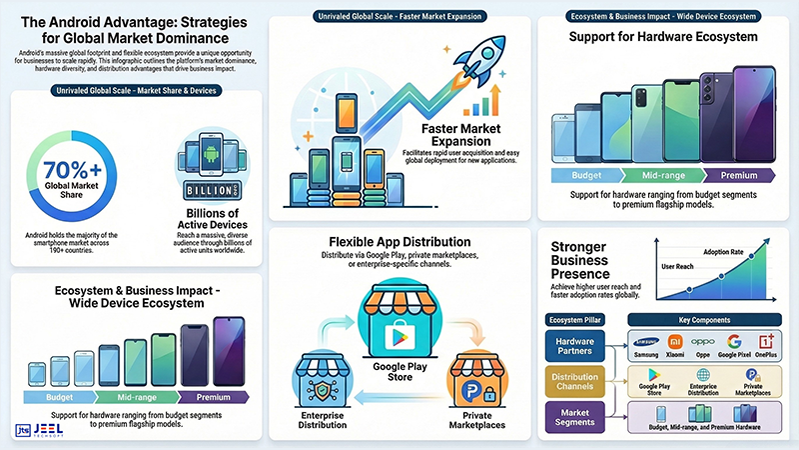
Android’s influence in the global smartphone market is difficult to ignore. According to StatCounter, Android consistently holds over 70% of the worldwide mobile operating system market share, making it the most widely used mobile platform. For businesses aiming to maximize user acquisition, that reach translates directly into opportunity.
The platform’s openness is one of its biggest strengths. Android supports a wide range of manufacturers from Samsung and Xiaomi to Google Pixel and OnePlus, allowing apps to reach users across price segments, regions, and device capabilities.
This diversity creates a powerful growth environment for companies launching mobile products.
Key reasons Android expands reach quickly include:
Global market penetration
- Android devices dominate markets in Asia, Africa, South America, and parts of Europe. Companies entering these regions often find Android to be the most practical entry point for mobile engagement.
Lower barriers for adoption
- Compared with other ecosystems, Android devices are available across various price ranges. This accessibility helps businesses connect with both premium and budget-conscious consumers.
Flexible distribution channels
- While Google Play remains the primary marketplace, Android allows alternative distribution methods such as enterprise stores, private installations, and partner marketplaces.
Faster experimentation cycles
- Android’s developer ecosystem encourages iterative releases, enabling companies to refine features quickly based on user behavior.
Organizations that invest in Android app development services can leverage these advantages to expand their digital presence without waiting for long product cycles. Businesses that integrate their mobile strategy with broader mobile app development services often see faster user acquisition and stronger engagement metrics.
For businesses seeking official guidance and technical documentation, the Android developer guidance resources provide extensive best practices for development and deployment.
Growth Levers for Android Apps
Launching an Android application is only the starting point. What truly accelerates market reach is how effectively businesses structure growth mechanisms around the app.
Successful Android apps often scale rapidly because they integrate growth drivers directly into the product architecture.
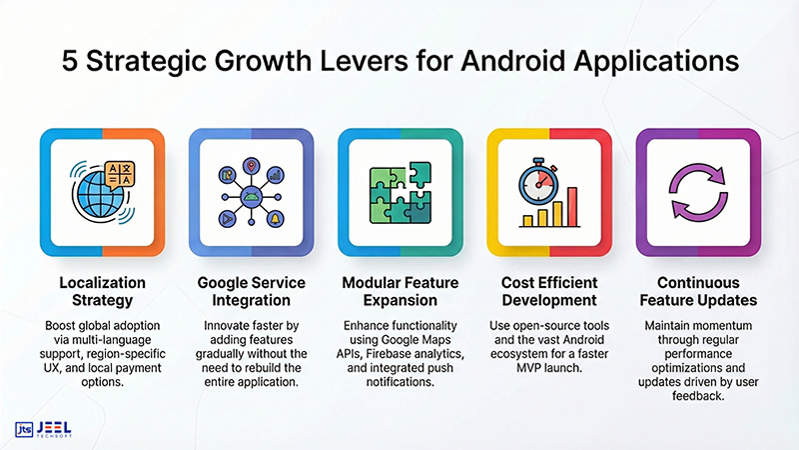
1. Localization and regional adaptation
Android’s global footprint means users come from diverse linguistic and cultural backgrounds. Apps that incorporate multilingual support and region-specific design often experience higher adoption.
For example:
- A fintech startup expanding into Southeast Asia is localizing onboarding screens and payment methods.
- Within six months, the company increased sign-ups by 38% in Indonesia and Vietnam.
Localization is not only about translation; it includes currency formats, payment integrations, and regionally relevant content.
2. Modular feature expansion
Android’s architecture supports modular development, allowing teams to introduce new features without rewriting the entire application.
A retail company might initially launch with basic product browsing. Later updates can introduce:
- loyalty programs
- personalized recommendations
- subscription features
Each update extends functionality while preserving the core app experience.
3. Integration with Google services
Android apps can integrate seamlessly with Google technologies such as:
- Google Maps APIs
- Firebase analytics
- Google Pay
These integrations simplify development while enabling advanced capabilities like real-time analytics, push notifications, and location-based services.
4. Cost-efficient scaling
A major advantage of Android development is its ability to support cost-effective app development strategies.
Several factors contribute to this efficiency:
- open-source development tools
- large developer community
- flexible deployment pipelines
Businesses can launch minimum viable products quickly and expand functionality as demand grows.
5. Strong ecosystem support
Android benefits from a massive ecosystem of development frameworks, SDKs, and third-party libraries.
This ecosystem reduces development time while allowing teams to build sophisticated features such as:
- biometric authentication
- real-time chat
- video streaming
- AI-powered recommendations
When these capabilities are combined with ongoing app maintenance services, companies can ensure their applications remain reliable, secure, and competitive over time.
Architecture Choices for Scalability
Rapid user growth introduces technical challenges. Apps must handle higher traffic, support diverse devices, and maintain smooth performance.
This is where thoughtful architectural decisions become essential.
Scalable architecture ensures that applications can grow without requiring major redesigns.
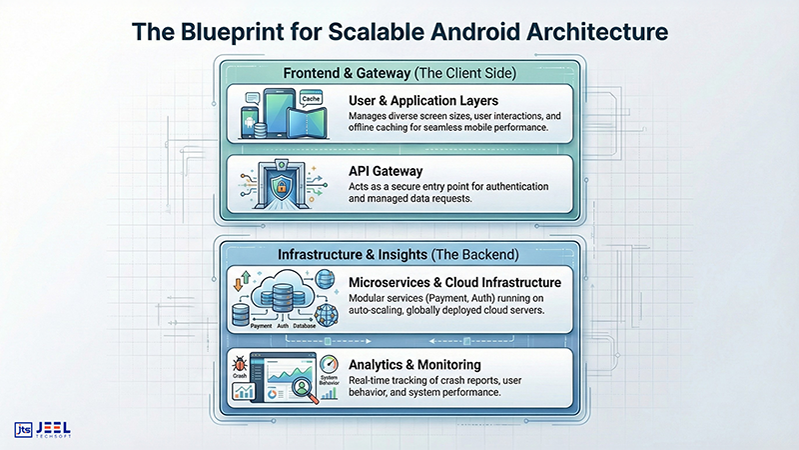
Microservices-based architecture
Microservices break the backend into smaller services that communicate through APIs.
Instead of one large backend system handling everything, individual services manage specific tasks such as:
- authentication
- payments
- notifications
- analytics
Benefits include:
- easier updates
- better performance optimization
- faster feature deployment
For high-growth apps, microservices significantly improve mobile app scalability.
Cloud-native infrastructure
Cloud platforms allow Android apps to handle sudden increases in users without performance degradation.
For example:
A fitness application launching a global challenge campaign might see thousands of simultaneous logins. Cloud infrastructure can automatically scale server resources during these peaks.
Cloud-native architecture supports:
- elastic scaling
- global server distribution
- improved reliability
Offline-first design
Many Android users operate in regions with inconsistent internet connectivity. Apps that rely solely on constant connectivity often struggle in such environments.
Offline-first architecture ensures the app continues functioning even without internet access.
Key techniques include:
- local data caching
- background synchronization
- lightweight data storage
Messaging apps and note-taking applications often use this model successfully.
Data-driven performance monitoring
Scalable systems require visibility into performance metrics.
Common monitoring indicators include:
- crash rates
- API latency
- user session duration
- retention metrics
Tools such as Firebase and Android Studio Profiler help developers identify bottlenecks and optimize performance.
These insights allow development teams to refine infrastructure before performance issues impact users.
Release Plan Testing Telemetry and Iteration
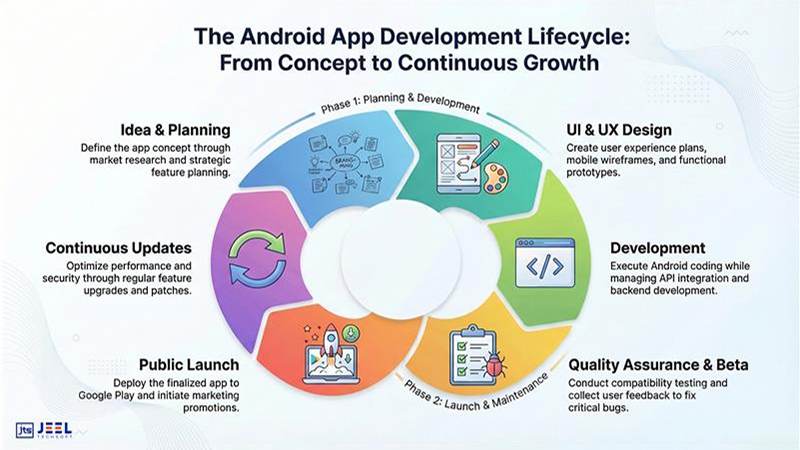
A well-structured release process helps Android apps evolve continuously without disrupting user experience.
Instead of launching large updates infrequently, successful teams adopt iterative release cycles.
Structured testing frameworks
Before releasing new features, apps typically undergo multiple testing layers:
- unit testing
- integration testing
- user acceptance testing
Android developers also rely heavily on beta testing programs to gather feedback from real users before public releases.
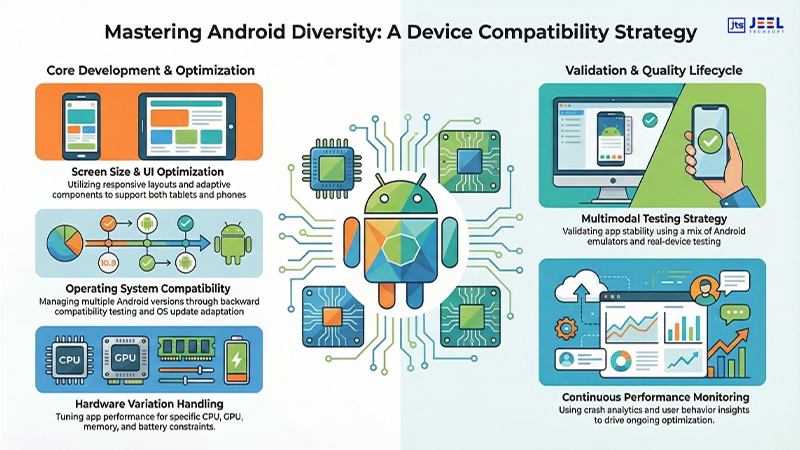
Device compatibility testing
One of Android’s biggest strengths, device diversity, can also create technical challenges.
Apps must function across:
- different screen sizes
- multiple hardware capabilities
- various Android OS versions
Practical tips for ensuring compatibility:
- Use responsive layouts to adapt to different screen sizes.
- Test apps on both high-end and budget devices.
- Validate functionality across multiple Android OS versions.
- Use Android emulators alongside physical device testing.
Companies that build compatibility testing into their development workflow significantly reduce user complaints related to performance or crashes.
Telemetry and user analytics
Telemetry systems collect real-time data about how users interact with the app.
Examples include:
- which screens users spend the most time on
- where drop-offs occur in onboarding
- how frequently certain features are used
These insights allow developers to prioritize updates that improve engagement.
Continuous iteration
Android apps that grow rapidly usually follow short development cycles.
A typical iteration model might look like:
- Launch a minimum viable feature
- Collect user behavior data.
- Identify improvement opportunities
- Release an optimized update.
This feedback-driven development process helps companies stay responsive to changing user expectations.


