
Many Magento stores struggle with organic traffic, not because of poor products or weak content, but because of hidden technical issues. Problems like duplicate URLs, inefficient crawl paths, heavy page scripts, and slow load times silently block search engines from properly indexing pages.
Strong magento seo optimization requires fixing these technical pitfalls, improving crawl efficiency, speeding up page delivery, and structuring Magento correctly for search engines.
When configured properly, Magento becomes a powerful SEO platform rather than a barrier to growth.
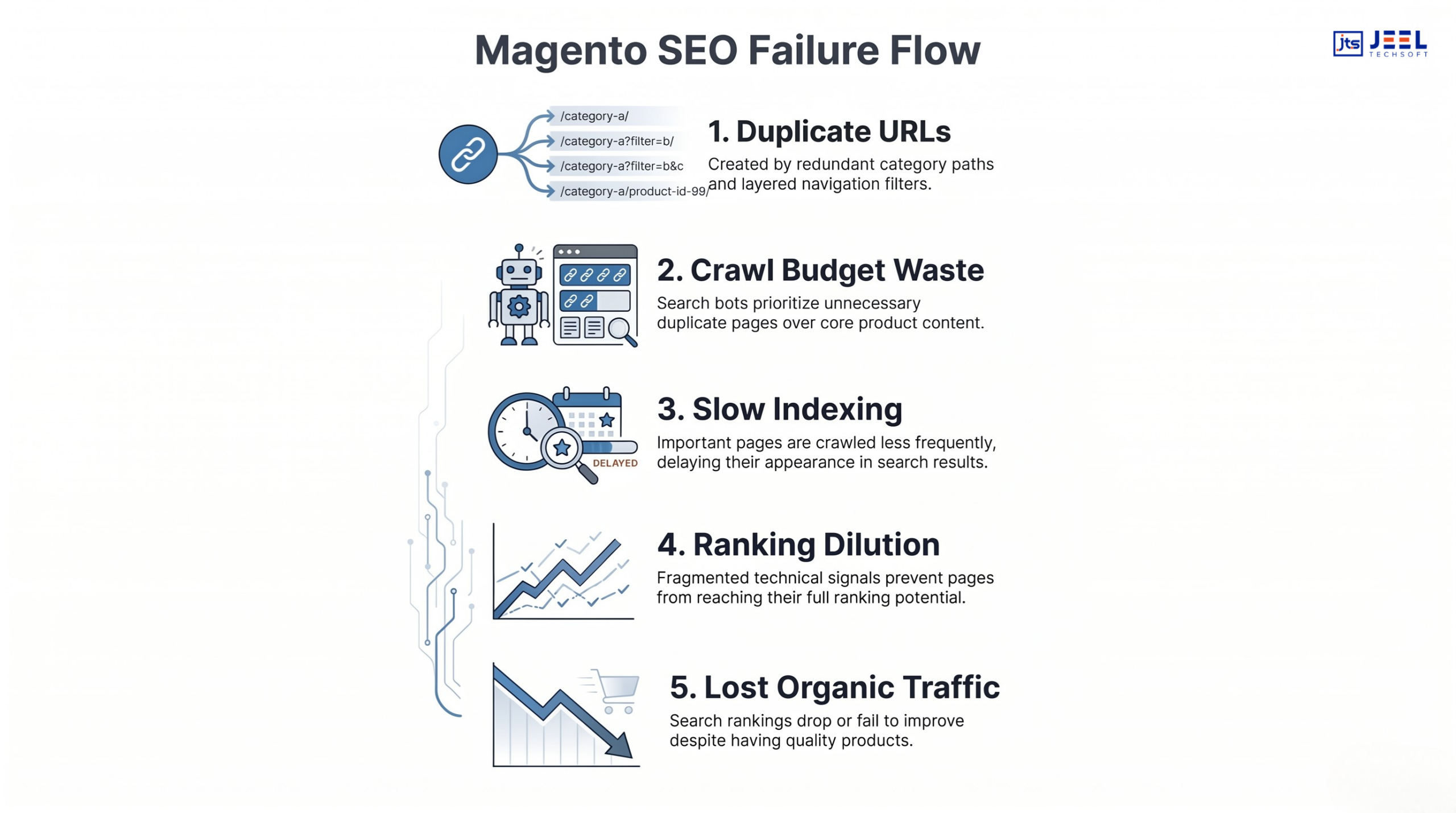
Why Magento SEO breaks silently
Magento is one of the most powerful ecommerce store development platforms available, but it is also technically complex. That complexity often leads to hidden SEO problems that accumulate over time without obvious warning signs.
Unlike platforms with rigid structures, Magento allows extensive customization. While this flexibility benefits developers and store owners, it can unintentionally create multiple indexing paths, duplicate URLs, and inefficient crawling structures.
The result is subtle but damaging: search engines struggle to interpret the site structure.
Common symptoms include:
- High indexation of duplicate product URLs
- Important category pages rarely appear in search results
- Slow crawling frequency by search engines
- Organic traffic is stagnating despite strong product demand
According to data from several ecommerce technical audits, nearly 60% of Magento stores contain duplicate URLs caused by layered navigation filters or category paths. These duplicates consume search engine resources and dilute ranking signals.
This is where proper magento seo optimization becomes essential.
Instead of focusing only on keywords or content, Magento stores must address structural SEO challenges first.
Technical SEO pitfalls
Magento sites often face a set of recurring technical issues that directly impact organic performance. These problems rarely trigger visible errors but quietly reduce ranking potential.
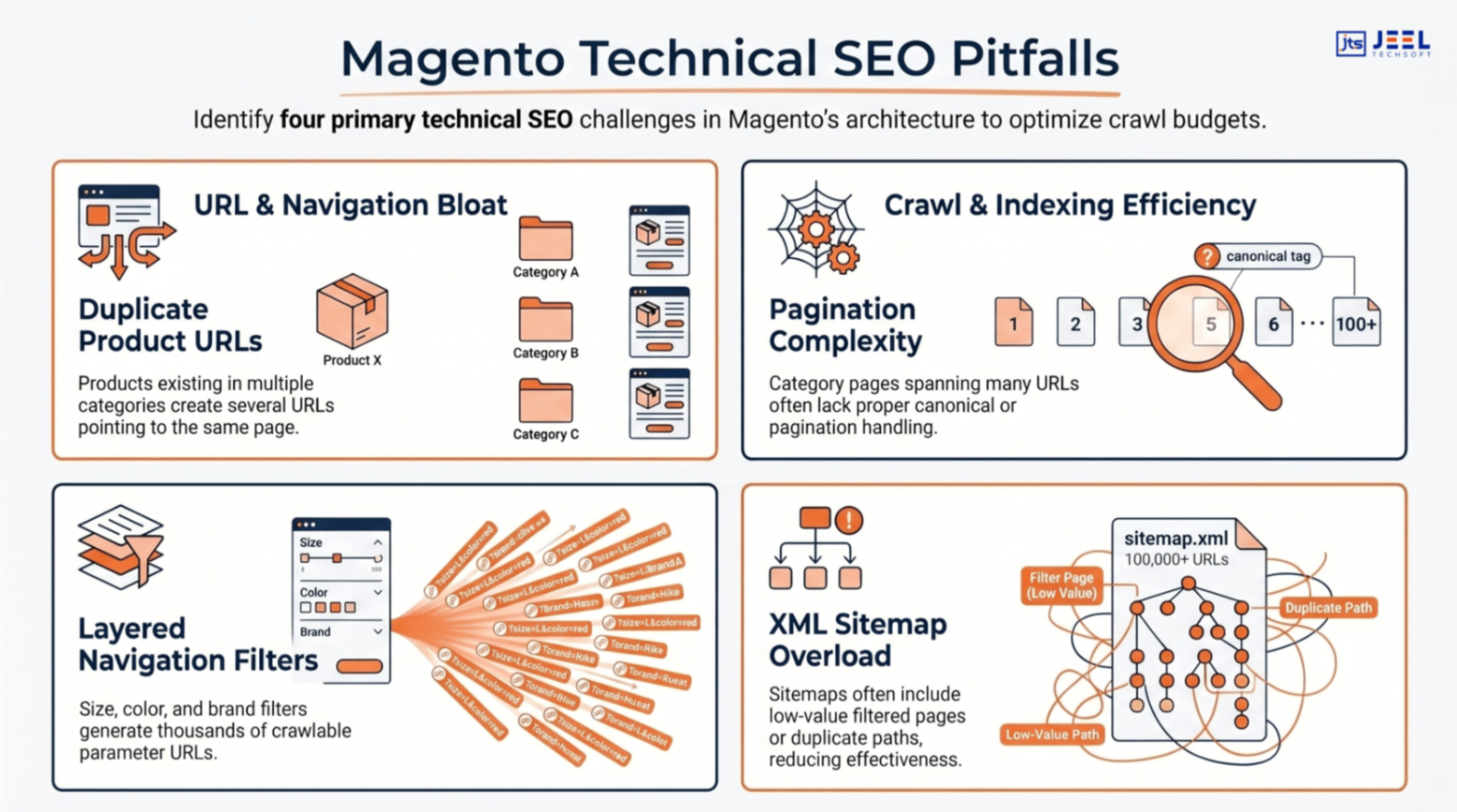
Duplicate URL structures
Magento commonly generates multiple URLs for the same product page.
For example:
/mens-shoes/nike-air-max
/nike-air-max
/shoes/running/nike-air-max
Each version may appear accessible to search engines. Without proper canonical tags or URL management, Google may treat them as separate pages.
This causes:
- Ranking dilution
- Crawl inefficiency
- Duplicate content signals
A strong ecommerce technical seo setup ensures that canonical tags consistently point to the preferred version of each product page.
Layered navigation indexing
Magento’s layered navigation filters are useful for shoppers but dangerous for SEO if indexed.
Filters like:
- size
- color
- price range
- brand
- material
create thousands of crawlable combinations.
Example:
/mens-shirts?color=blue
/mens-shirts?size=large
/mens-shirts?brand=nike&size=large
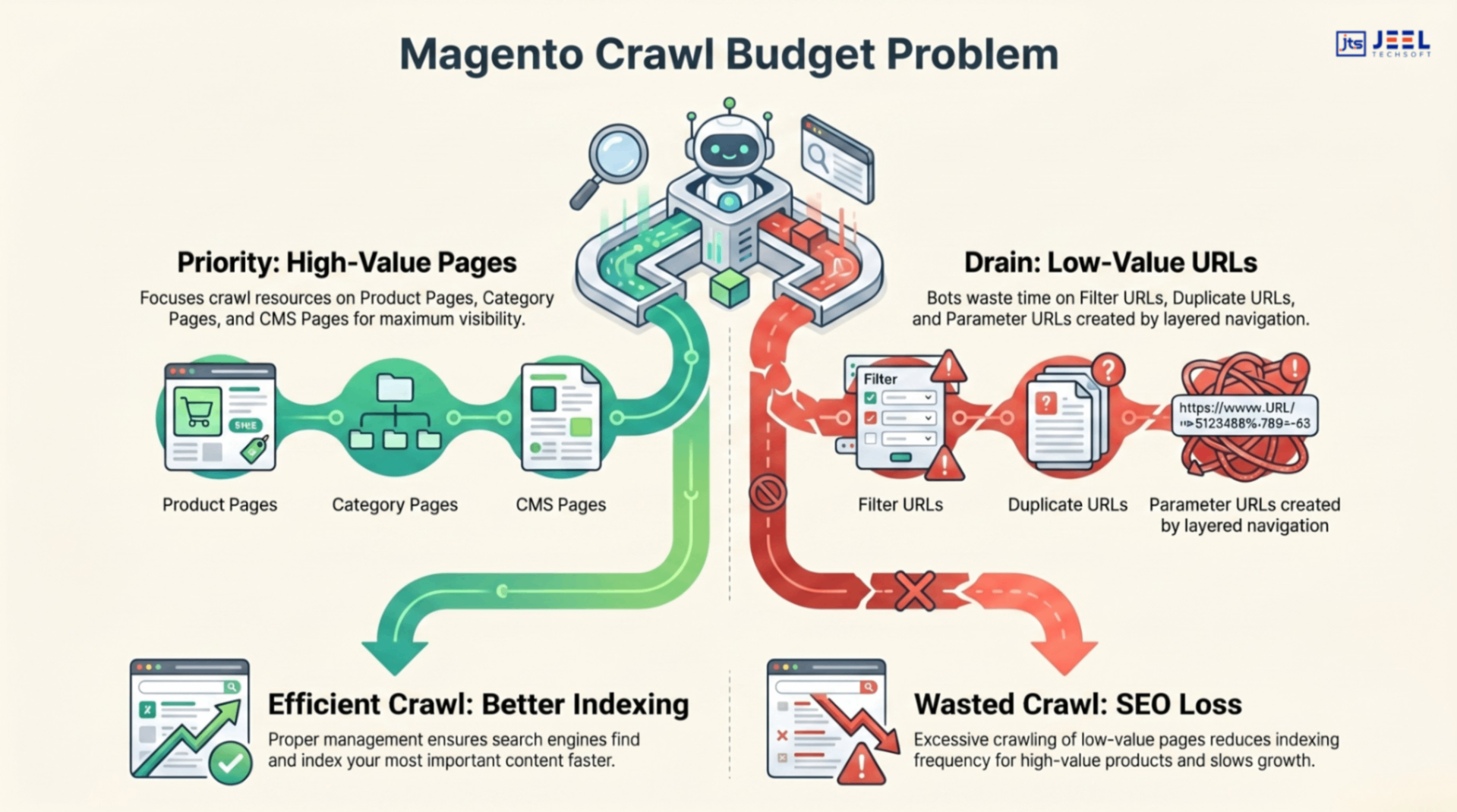
If these pages remain indexable, search engines waste valuable crawl budget on pages that offer little unique value.
Best practice includes:
- Blocking parameter URLs via robots.txt or meta directives
- Allowing indexing only for valuable filter combinations (if strategically beneficial)
- Configuring Magento navigation settings properly
Without this control, search engines spend time crawling endless variations rather than important product and category pages.
Category pagination problems
Magento category pages frequently span multiple paginated URLs:
/mens-jackets?page=1
/mens-jackets?page=2
/mens-jackets?page=3
Improper pagination configuration can confuse search engines about which page holds primary authority.
Typical issues include:
- Missing rel=”next” and rel=”prev” structure
- Canonical tags are pointing incorrectly
- Pagination pages accidentally indexed with duplicate titles
This leads to diluted rankings across multiple pages instead of concentrating authority on the main category page.
XML sitemap overload
Magento automatically generates sitemaps, but many stores unknowingly include unnecessary URLs such as:
- parameter-based filter pages
- session-based URLs
- duplicate category paths
Search engines rely on sitemaps as signals of priority content. When sitemaps contain thousands of low-value URLs, they send the wrong signals.
A well-managed sitemap should prioritize:
- canonical product URLs
- core category pages
- CMS content pages
This improves crawling efficiency and strengthens crawl budget allocation.
Speed and Indexing Problems
Even technically clean Magento sites often struggle with performance issues that directly affect SEO.
Search engines increasingly evaluate page performance when ranking ecommerce pages.
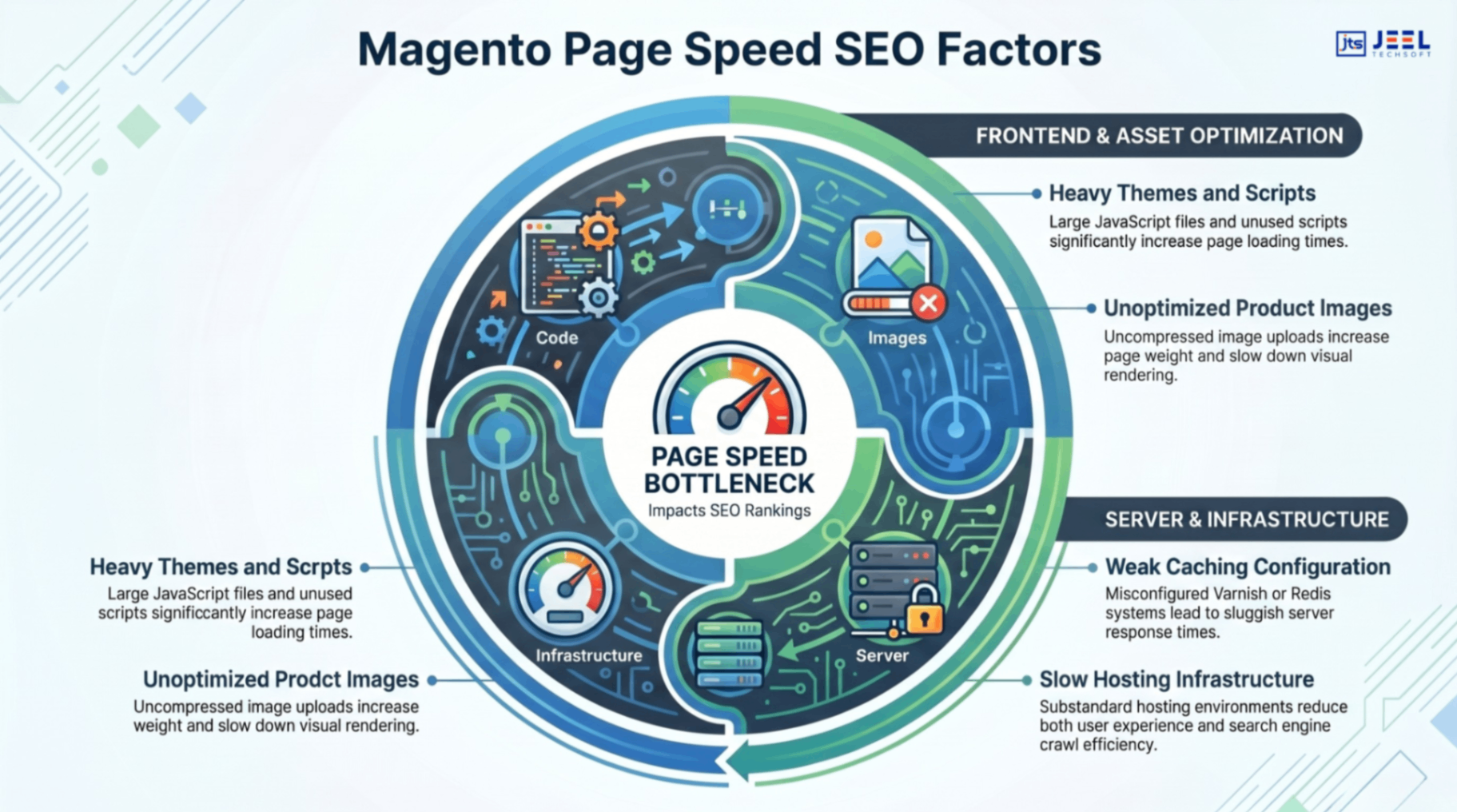
Magento stores commonly encounter problems related to page weight, script execution, and indexing delays.
Heavy theme structures
Magento themes often include large bundles of JavaScript and CSS files.
Some themes load:
- unused scripts
- heavy animation libraries
- multiple tracking integrations
This significantly increases page load time.
Research from HTTP Archive indicates that the average ecommerce page exceeds 2.3MB in total size, with scripts contributing the majority of that weight.
Poor performance directly harms site speed, especially on mobile devices.
Unoptimized image delivery
Product pages typically contain several high-resolution images. When those images are not optimized, page weight grows quickly.
Common mistakes include:
- uploading original camera-sized images
- missing next-gen formats like WebP
- no lazy-loading implementation
For example:
A single 2MB product image displayed across multiple thumbnails and zoom views can dramatically slow page rendering.
Proper Magento optimization includes:
- automated image compression
- responsive image sizing
- CDN delivery
These changes alone can reduce page weight by 30–50%.
Inefficient caching setup
Magento relies heavily on caching systems.
Without proper caching configuration, every page request may require dynamic server processing.
Common caching issues include:
- disabled full-page cache
- missing Varnish configuration
- improperly configured Redis cache
When Magento caching is correctly implemented, pages can load several times faster.
This significantly improves site speed, especially for category pages that receive the majority of organic traffic.
Indexing delays caused by server latency
Search engines crawl large ecommerce websites gradually. Slow server response times reduce crawl frequency.
If a server takes several seconds to respond, search engine bots crawl fewer pages per visit.
This restricts the indexing of new products and updated content.
Improving server performance through optimized hosting infrastructure helps ensure search engines crawl more pages efficiently.
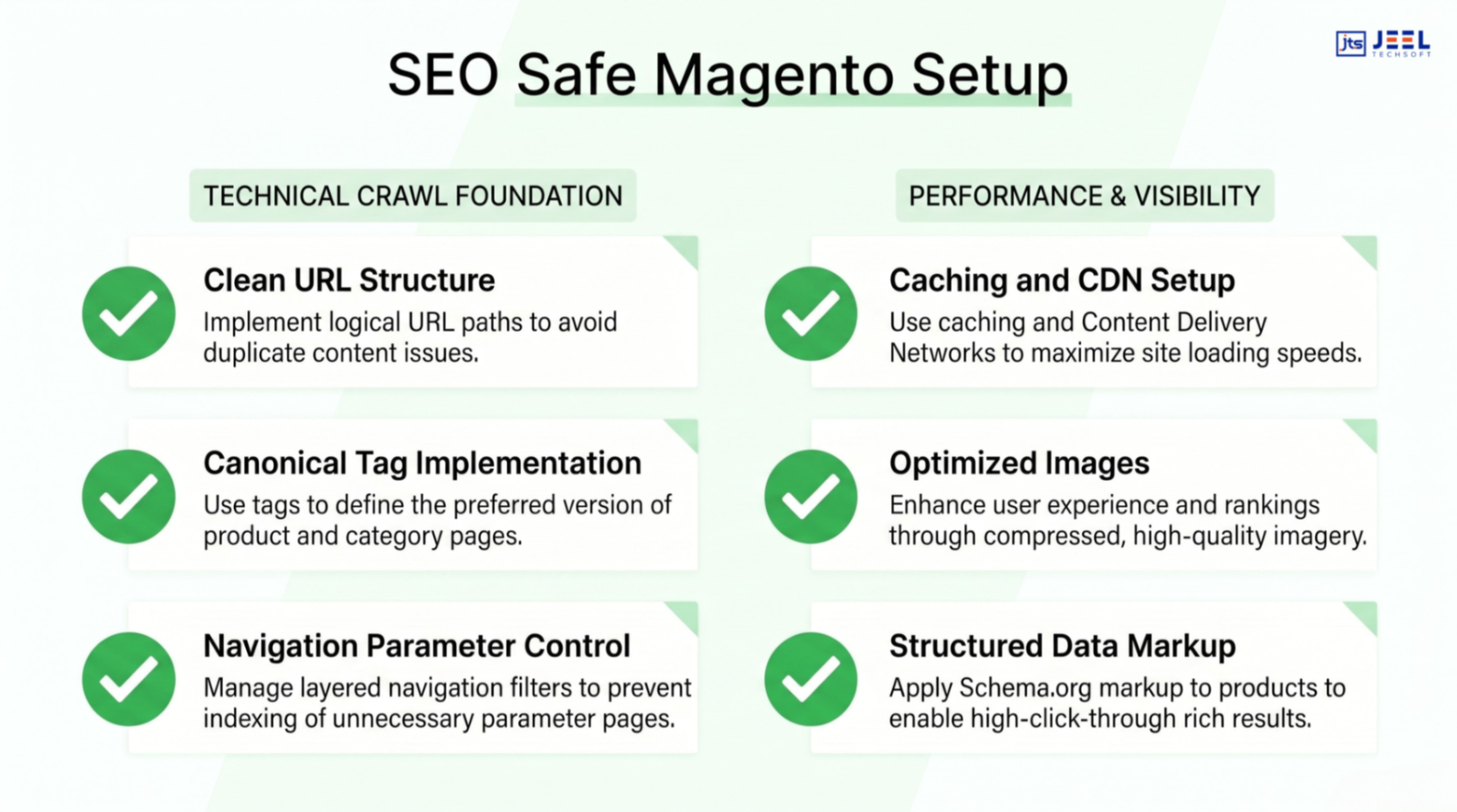
SEO safe Magento Setup
A technically optimized Magento site avoids the majority of SEO pitfalls.
Below are the core principles used by experienced developers when implementing magento seo optimization.
Clean URL architecture
Magento stores should enforce one consistent product URL format.
Recommended structure:
/category/product-name
Alternatively, flat URLs may be used depending on the catalog structure.
What matters most is consistency and canonical alignment.
Canonical control
Every product and category page must define its canonical version.
Magento allows configuration of canonical tags through:
- product settings
- category settings
- SEO extensions
Canonical tags prevent duplicate indexing across category paths and navigation layers.
Parameter management
Magento parameters should be carefully controlled.
Best practices include:
- Disallow unnecessary parameters via robots.txt
- configure parameter handling in Google Search Console
- block indexing of layered navigation pages
This ensures search engines focus their crawl budget on valuable pages.
Performance optimization
Speed improvements are one of the most impactful technical upgrades for Magento stores.
A safe Magento performance setup includes:
- full-page caching with Varnish
- optimized hosting infrastructure
- CDN distribution
- compressed image formats
- script bundling and minification
These improvements directly support site speed seo.
Structured data implementation
Magento product pages should include structured data markup for:
- product information
- price
- availability
- review ratings
This allows search engines to generate rich search results, improving visibility and click-through rates.
Structured data also helps search engines better understand product relationships within the store catalog.
Internal linking architecture
Magento categories and product relationships play a critical role in SEO.
Effective linking includes:
- linking products to multiple relevant categories
- using breadcrumb navigation
- linking informational content to product categories
Strong internal linking ensures authority flows through the site effectively.
If you are building or improving a Magento store, these improvements are often implemented alongside professional Magento development services, SEO services, and broader ecommerce development solutions to ensure the platform is optimized both technically and strategically.
FAQs
Why does Magento SEO fail?
- Magento SEO often fails because the platform generates duplicate URLs, layered navigation parameters, and crawl inefficiencies that dilute ranking signals and consume crawl budget.
What is the biggest Magento SEO problem?
- Duplicate product URLs and layered navigation filters are among the most damaging Magento SEO issues because they create thousands of unnecessary pages for search engines to crawl.
How does the crawl budget affect Magento stores?
- Large Magento stores often contain tens of thousands of URLs. If search engines waste time crawling parameter pages or duplicate URLs, they may ignore important product or category pages.
Does site speed impact Magento rankings?
- Yes. Slow-loading pages reduce user engagement and limit crawl efficiency. Improving performance is a critical part of site speed seo and Magento optimization.
How can Magento stores improve technical SEO?
- Magento stores improve ecommerce technical seo by fixing duplicate URLs, optimizing navigation filters, improving caching systems, compressing images, and ensuring clean canonical structures.
Conclusion
Magento is capable of powering highly successful ecommerce businesses, but its flexibility often introduces technical complexity that quietly harms search visibility.
Many stores invest heavily in advertising or content marketing while overlooking structural SEO problems within the platform itself.
Duplicate URLs, inefficient navigation filters, slow page performance, and indexing inefficiencies are among the most common causes of lost organic growth.
Addressing these issues requires a deliberate technical approach focused on crawl efficiency, page performance, and clean site architecture.
When Magento is configured with SEO principles in mind, it transforms from a technically heavy platform into a powerful engine for long-term organic traffic.
The difference between stagnating rankings and sustained growth often comes down to how carefully these hidden technical traps are addressed.


