Strong PHP application security practices are no longer optional for businesses running websites, portals, SaaS platforms, CRMs, eCommerce stores, or internal systems on PHP. Security vulnerabilities can expose customer data, damage brand reputation, trigger compliance issues, and disrupt operations.
Businesses that invest in secure coding, regular updates, penetration testing, and proactive monitoring reduce risks while building long-term customer trust. This guide explains the most common PHP vulnerabilities, practical protection methods, and why ongoing maintenance plays a critical role in secure business growth.
Why PHP security matters now
PHP powers a significant portion of the modern web. From enterprise portals to eCommerce platforms and custom business applications, organizations continue to rely on PHP because of its flexibility, scalability, and mature ecosystem.
However, popularity comes with exposure.
Cybercriminals actively target PHP-based systems because poorly configured applications, outdated plugins, insecure authentication flows, and vulnerable APIs create easy entry points. Businesses that ignore security often realize the impact only after a breach occurs.
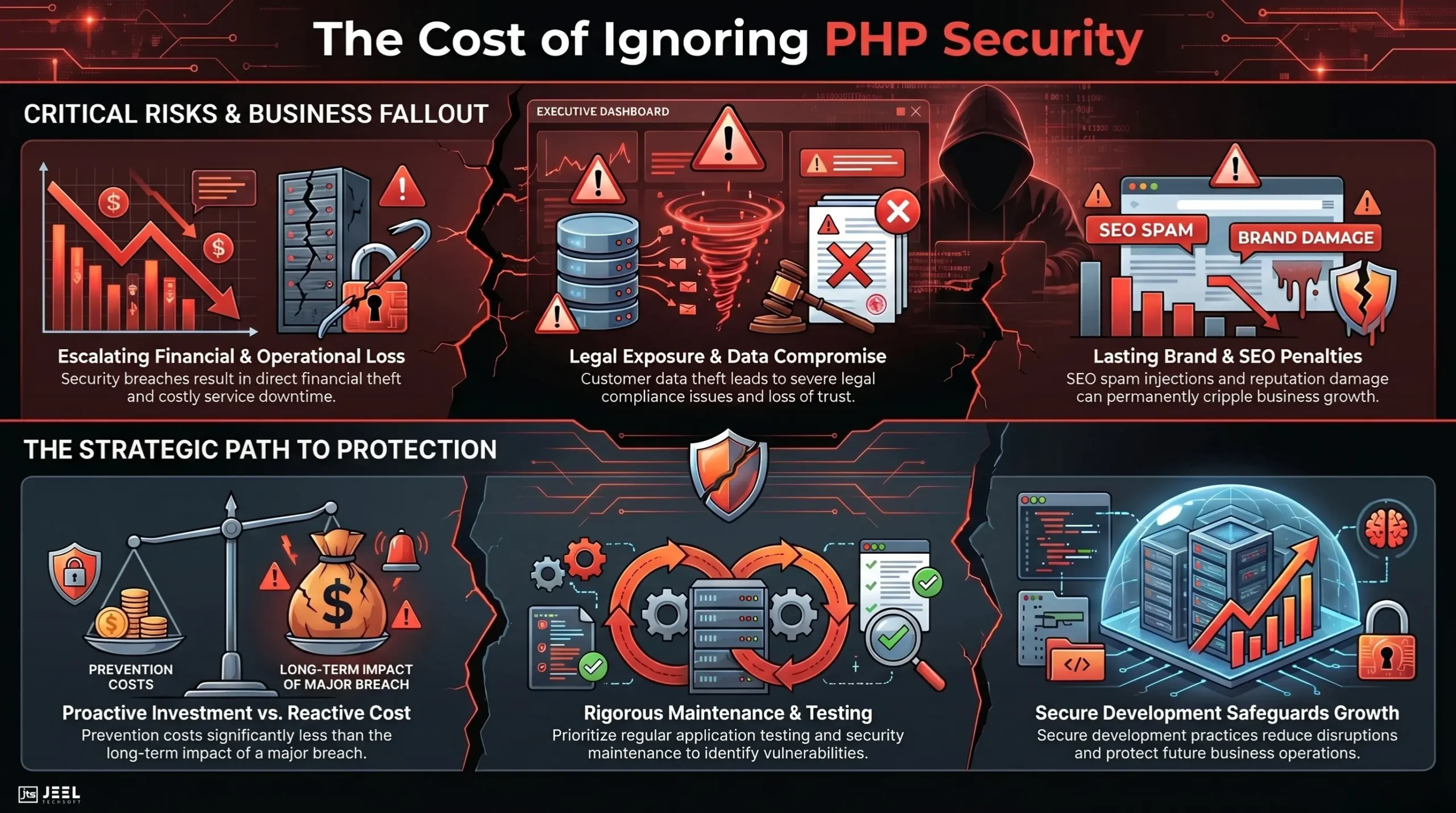
The consequences extend far beyond technical damage.
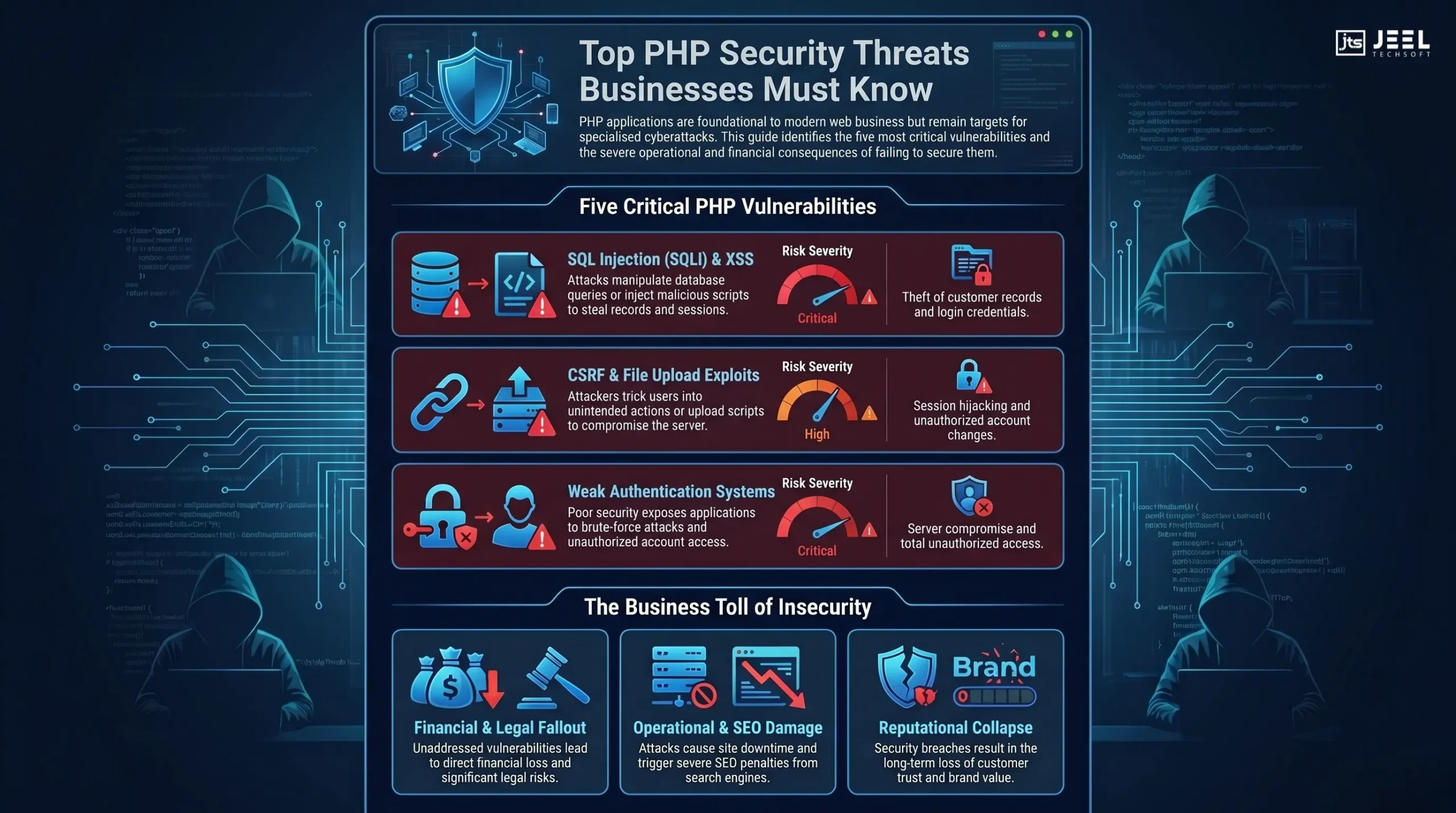
A compromised application can lead to:
- Customer data theft
- Financial fraud
- SEO spam injections
- Ransomware attacks
- Service downtime
- Regulatory penalties
- Reputation loss
According to IBM’s Cost of a Data Breach Report, the global average cost of a data breach crossed millions of dollars in recent years, with web application vulnerabilities remaining one of the leading attack vectors.
For growing businesses, security is directly tied to operational continuity and customer trust.
A secure application environment also improves:
- Customer confidence
- Compliance readiness
- Platform stability
- Scalability
- Search engine trust
- Conversion rates
This is why many organizations now combine secure development processes with professional web security services and continuous monitoring frameworks.
Businesses investing in modern PHP development services increasingly prioritize security-first architecture from the initial development phase rather than treating security as a post-launch fix.
Common vulnerabilities
PHP applications face several recurring security threats. Many of them are preventable, yet they continue appearing in business applications because of rushed development cycles, weak testing processes, or outdated systems.
Understanding these vulnerabilities is the first step toward building safer applications.
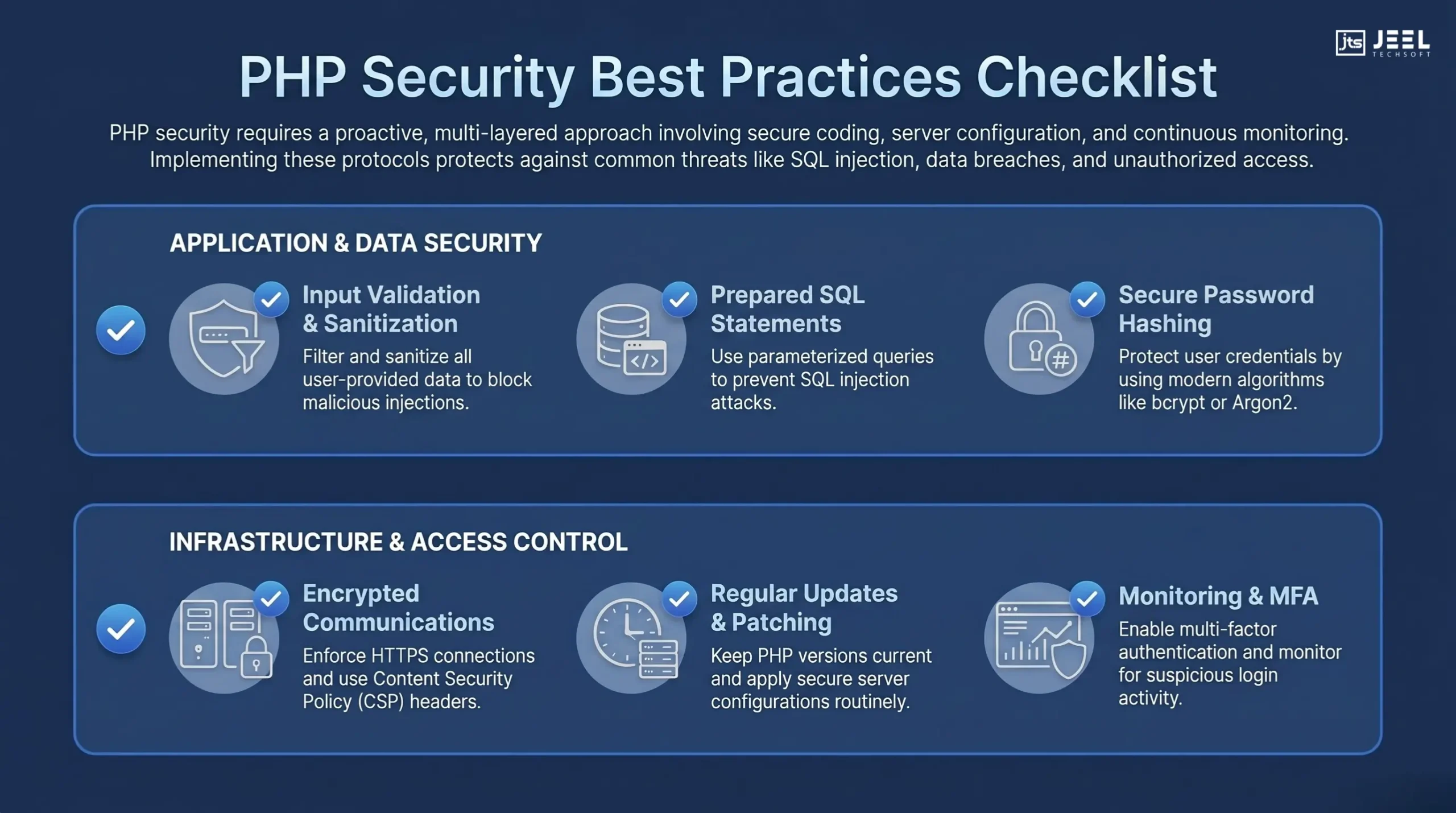
SQL Injection (SQLi)
SQL Injection remains one of the most dangerous web vulnerabilities.
It happens when attackers manipulate database queries through unsafe user inputs. If an application directly inserts user-submitted data into SQL queries without validation or parameterization, attackers can gain unauthorized access to sensitive records.
For example:
- Customer databases
- Login credentials
- Financial records
- Internal business information
A vulnerable login form or search field can become an entry point.
Prevention methods:
- Use prepared statements
- Implement parameterized queries
- Avoid raw SQL concatenation
- Use ORM frameworks carefully
- Validate all input fields
PDO and MySQLi prepared statements significantly reduce SQL injection risks when properly implemented.
Cross-Site Scripting (XSS)
XSS attacks occur when malicious scripts are injected into webpages viewed by users.
Attackers use XSS to:
- Steal session cookies
- Hijack user accounts
- Redirect visitors
- Inject malware
- Manipulate website content
PHP applications handling comments, forms, chat systems, or user-generated content are especially vulnerable.
Security best practices include:
- Escaping output using htmlspecialchars()
- Sanitizing user inputs
- Implementing Content Security Policy (CSP)
- Validating form submissions
Even a simple unescaped form field can expose an application to large-scale exploitation.
Cross-Site Request Forgery (CSRF)
CSRF attacks trick authenticated users into performing actions they did not intend.
For example, an attacker may force a logged-in admin to unknowingly:
- Change account settings
- Transfer funds
- Delete records
- Approve transactions
Protection strategies:
- CSRF tokens
- SameSite cookie attributes
- Session validation
- Multi-factor authentication
Modern PHP frameworks often include built-in CSRF protection, but developers must ensure it is enabled correctly.
File Upload Vulnerabilities
File upload features are common in business applications.
Without proper validation, attackers can upload malicious scripts disguised as images or documents.
This can lead to:
- Remote code execution
- Server compromise
- Malware deployment
Secure upload handling includes:
- Restricting file types
- Validating MIME types
- Renaming uploaded files
- Storing uploads outside public directories
- Scanning files for malware
Many professional application testing services specifically assess file upload functionality because it remains a common attack surface.
Weak Authentication and Session Management
Poor password policies and insecure session handling expose applications to unauthorized access.
Common issues include:
- Weak password requirements
- Predictable session IDs
- Missing session expiration
- Storing passwords in plain text
Businesses should implement:
- Password hashing with bcrypt or Argon2
- Multi-factor authentication
- Secure session handling
- Login rate limiting
- IP monitoring
Authentication security becomes especially important for SaaS platforms, financial portals, healthcare systems, and admin dashboards.
Outdated Dependencies and Plugins
Many PHP applications rely on third-party packages and libraries.
Outdated dependencies often contain publicly known vulnerabilities.
Attackers actively scan websites for:
- Old CMS versions
- Vulnerable plugins
- Unsupported PHP versions
- Deprecated libraries
Businesses should:
- Maintain dependency inventories
- Apply updates regularly
- Monitor vulnerability advisories
- Remove unused packages
Composer dependency management helps streamline updates while improving visibility into package versions.
Security best practices
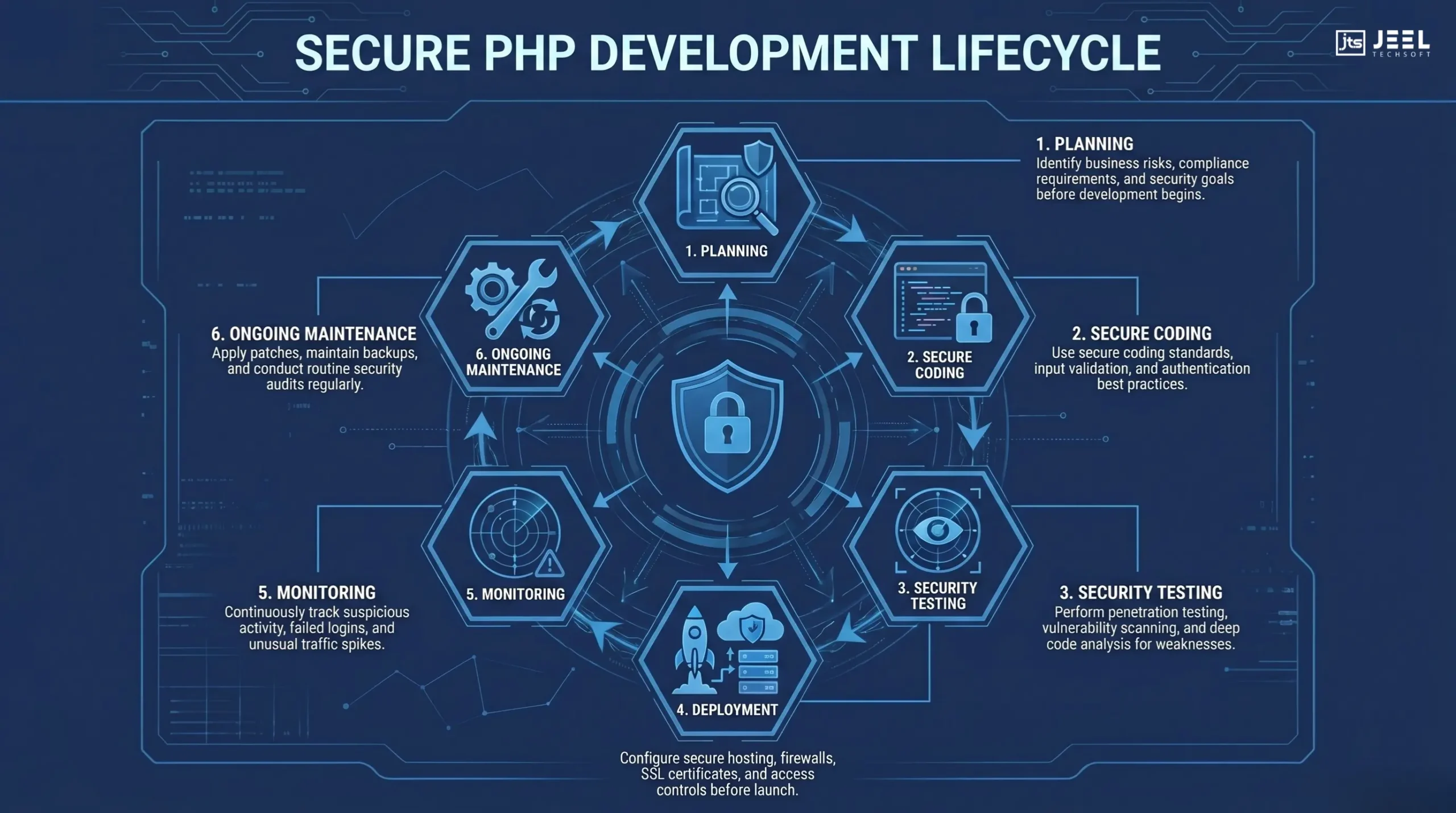
Security should not be treated as a single feature. It must become part of the development lifecycle.
Organizations using professional PHP development services increasingly adopt DevSecOps workflows that integrate security into planning, coding, deployment, and maintenance.
Here are the most effective security practices businesses should implement.
Use Secure Coding Standards
Secure coding reduces vulnerabilities before deployment.
Development teams should follow established standards such as:
- OWASP Secure Coding Practices
- PSR coding standards
- Input validation guidelines
- Secure authentication workflows
Security-focused code reviews help identify risky patterns early.
Examples include:
- Unsafe SQL queries
- Hardcoded credentials
- Weak encryption methods
- Insecure API endpoints
Building secure architecture from day one costs significantly less than fixing breaches later.
Validate and Sanitize Every Input
Every external input should be considered untrusted.
This includes:
- Form fields
- URL parameters
- API payloads
- Cookies
- File uploads
Input validation prevents malformed or malicious data from entering the application.
Recommended practices:
- Validate data types
- Restrict allowed values
- Apply server-side validation
- Sanitize outputs before rendering
Client-side validation alone is never sufficient.
Encrypt Sensitive Data
Sensitive business and customer information must be protected both in transit and at rest.
Encryption should apply to:
- Passwords
- Payment details
- API keys
- Personal records
- Authentication tokens
Businesses should:
- Use HTTPS everywhere
- Implement TLS certificates
- Hash passwords securely
- Encrypt stored sensitive data
Weak encryption practices remain a major compliance issue in industries handling financial or healthcare data.
Configure Secure Server Environments
Application security extends beyond code.
Server misconfigurations often create exploitable weaknesses.
Important server-level protections include:
- Disabling unnecessary PHP functions
- Restricting directory permissions
- Hiding PHP version details
- Enabling firewalls
- Configuring secure headers
Security headers like:
- Content-Security-Policy
- X-Frame-Options
- X-Content-Type-Options
help reduce browser-based attacks.
Businesses using managed hosting environments often combine infrastructure hardening with specialized web security services for continuous monitoring.
Perform Regular Security Testing
Security testing should happen continuously, not just before launch.
Professional application testing services help identify vulnerabilities before attackers do.
Testing methods typically include:
- Penetration testing
- Vulnerability scanning
- Static code analysis
- Dynamic application security testing
- API security testing
Routine testing helps businesses:
- Detect emerging vulnerabilities
- Validate security controls
- Improve compliance readiness
- Reduce breach risks
Organizations handling sensitive data often schedule quarterly penetration tests as part of risk management programs.
Implement Access Control Properly
Not every user should access every feature.
Role-based access control helps limit damage even if accounts are compromised.
Best practices include:
- Principle of least privilege
- Separate admin roles
- Restricted database permissions
- Audit logs for sensitive actions
Access management becomes critical for enterprise dashboards, HR systems, CRMs, and multi-user SaaS platforms.
Monitor Logs and Suspicious Activity
Security monitoring helps businesses identify attacks early.
Logging should include:
- Failed login attempts
- File modifications
- Permission changes
- API misuse
- Unusual traffic spikes
Monitoring tools can detect:
- Brute-force attacks
- Credential stuffing
- Malware activity
- Suspicious IP behavior
Businesses with mature security strategies often integrate SIEM platforms for centralized monitoring.
Ongoing maintenance
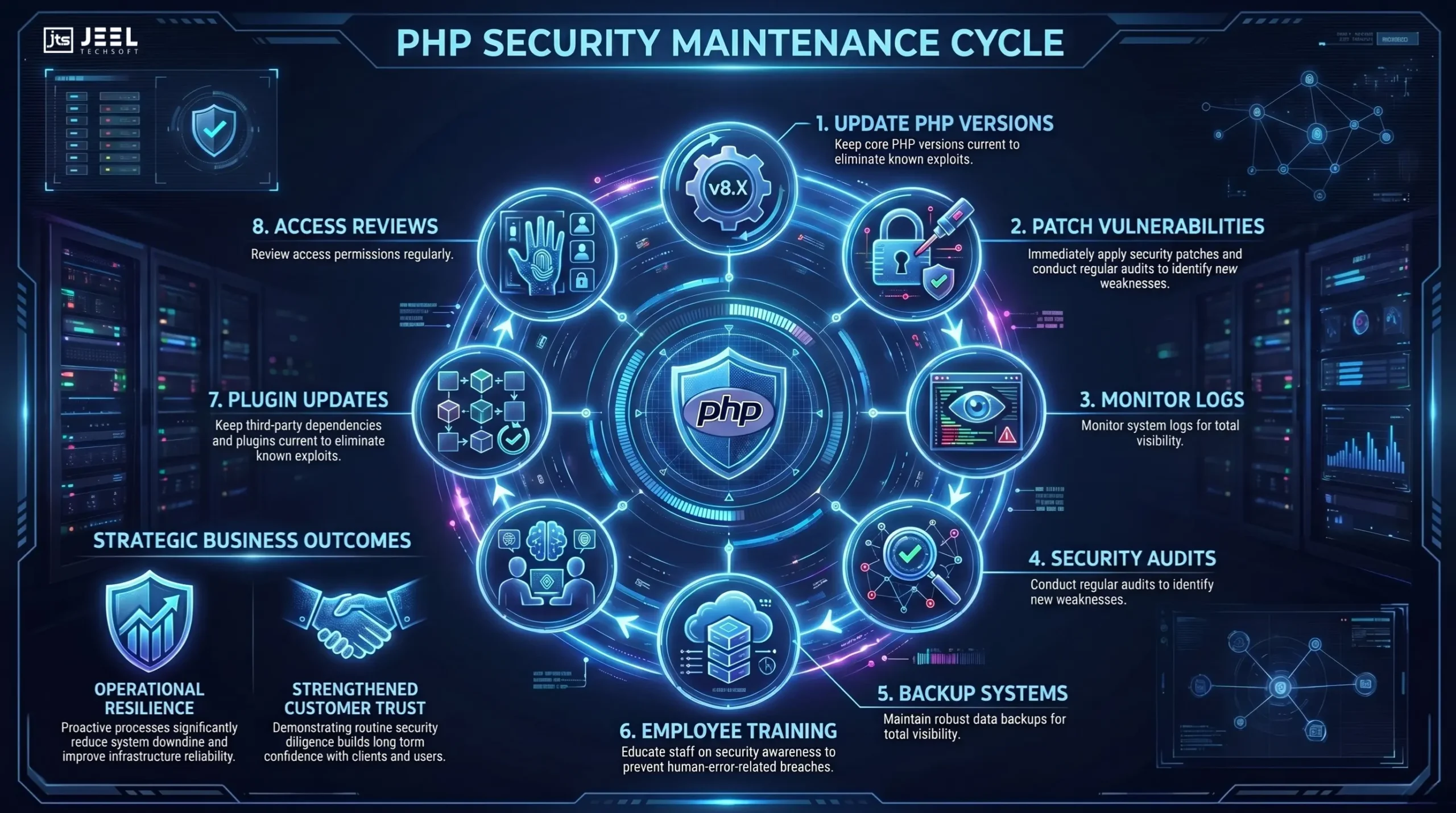
Security is not a one-time project.
Even well-built PHP applications become vulnerable if maintenance is ignored.
Attack methods constantly evolve. New vulnerabilities appear in frameworks, plugins, APIs, and hosting environments every month.
This makes ongoing maintenance essential for long-term business protection.
Keep PHP Versions Updated
Running outdated PHP versions exposes applications to publicly documented vulnerabilities.
Each new PHP release includes:
- Security patches
- Performance improvements
- Bug fixes
Businesses should maintain supported PHP versions and avoid end-of-life releases.
Conduct Routine Security Audits
Regular audits help identify weaknesses before attackers exploit them.
Audits should review:
- User permissions
- Database access
- Third-party integrations
- API security
- Backup systems
Security audits also support compliance requirements for industries handling customer data.
Backup and Recovery Planning
Even secure systems can face unexpected incidents.
Reliable backup strategies help businesses recover quickly from:
- Ransomware attacks
- Server failures
- Data corruption
- Human errors
Best practices include:
- Automated backups
- Offsite storage
- Backup encryption
- Recovery testing
Recovery plans should define clear response procedures to minimize downtime.
Employee Security Awareness
Human error remains one of the largest security risks.
Employees should receive training on:
- Phishing attacks
- Password security
- Suspicious links
- Secure file handling
Security awareness programs reduce preventable breaches caused by social engineering attacks.
Partner with Security-Focused Experts
Businesses often lack internal security expertise.
Working with experienced providers offering:
- PHP development services
- web security services
- application testing services
helps organizations maintain stronger protection across development and operations.
A proactive security strategy ultimately supports sustainable business growth, customer trust, and operational resilience.


