Choosing the right AI digital marketing agency is not about hiring the team with the most tools. It is about finding a growth partner that understands your business goals, customer journey, brand voice, data, and revenue model. AI can speed up research, campaign testing, audience analysis, reporting, content optimization, and automation, but it still needs experienced marketers to guide strategy, review quality, and connect activity with real ROI.
AI is changing how marketing teams plan, execute, and measure campaigns. But for business owners, the real question is not “Which AI tool should we use?” The better question is: “Which agency can use AI to make smarter marketing decisions for our business?”
That difference matters.
A strong AI digital marketing agency should help you improve SEO visibility, paid ad efficiency, content quality, customer targeting, email performance, conversion tracking, and reporting. But it should not treat AI as a shortcut for strategy. The best results come when automation supports experienced human judgment.
McKinsey notes that AI-driven personalization can improve customer satisfaction by 15% to 20%, increase revenue by 5% to 8%, and reduce cost to serve by up to 30% when supported by strong data and execution systems. That is a useful reminder: AI works best when it is connected to clean data, strong processes, and clear business goals.
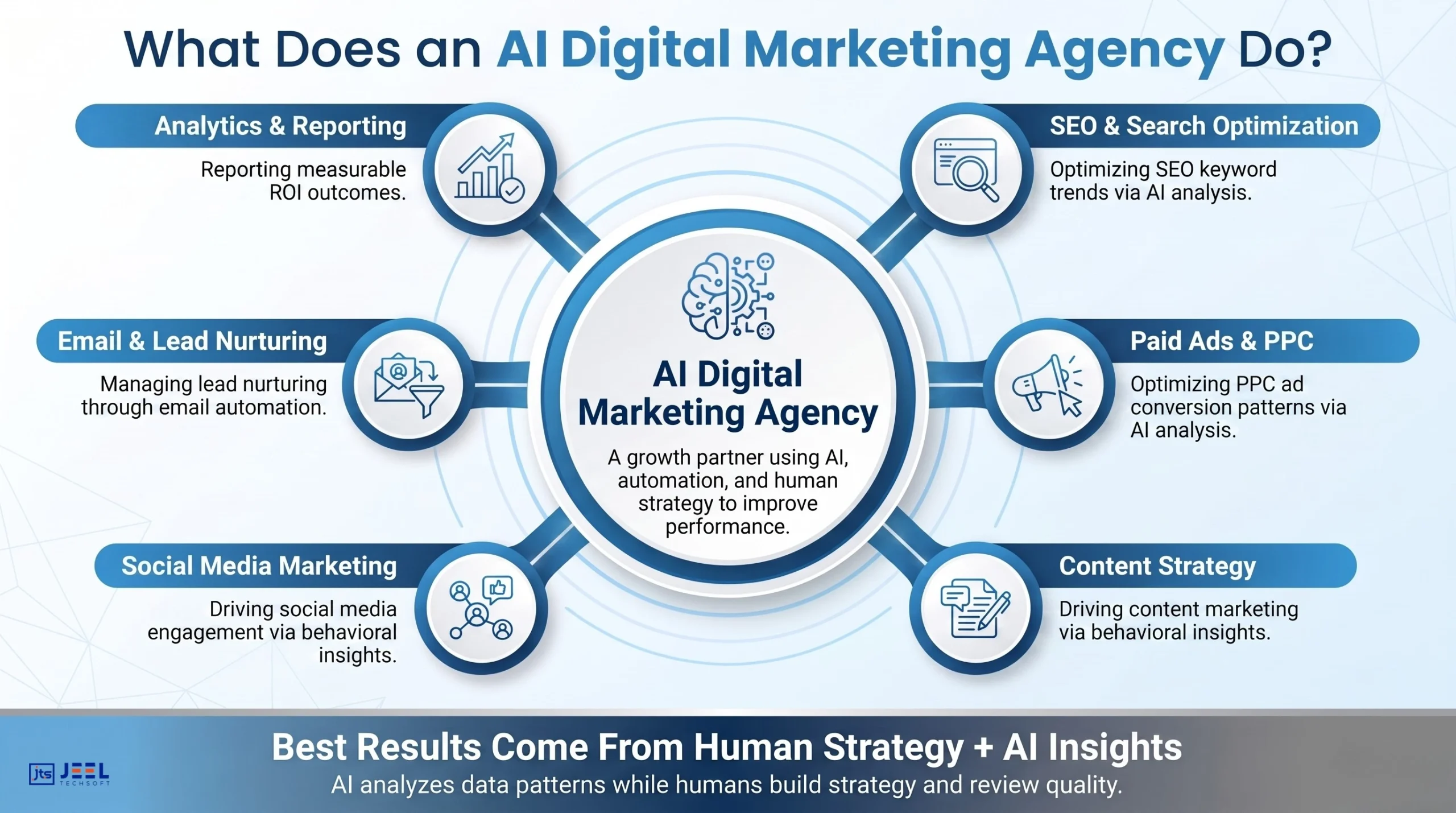
What is an AI Digital Marketing Agency?
An AI digital marketing agency is a marketing partner that uses artificial intelligence, automation, analytics, and machine learning-supported workflows to improve how campaigns are planned, managed, optimized, and reported.
This type of agency may support SEO, PPC, content marketing, social media, email marketing, marketing automation, conversion tracking, customer segmentation, and reporting. The real value is not the AI itself. The value is how the agency uses AI to make better marketing decisions faster.
For example, a traditional agency may review keyword data manually once a month. An AI-powered agency may analyze search patterns, competitor movement, content gaps, paid search trends, and conversion behavior more frequently. But a human strategist still needs to decide which opportunities are worth acting on.
For businesses comparing partners, this is the first thing to understand: AI should improve the marketing process, not replace marketing thinking.
How AI is used in Digital Marketing
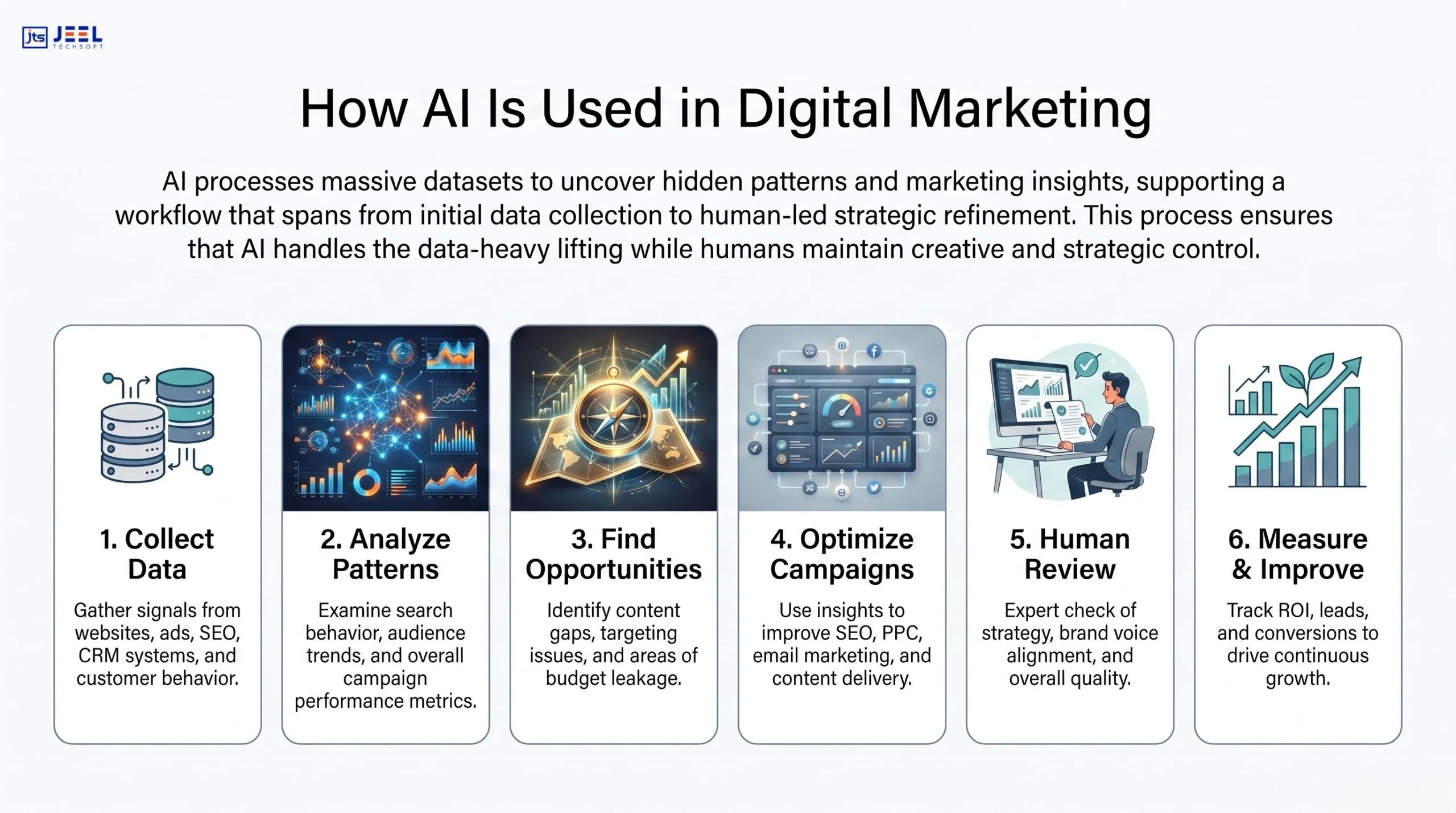
AI in digital marketing is used to process large amounts of data, identify audience patterns, improve campaign targeting, support content planning, automate repetitive tasks, and generate performance insights.
Common use cases include:
- Keyword research and search intent analysis
- Audience segmentation for ads and email campaigns
- Predictive analysis for campaign performance
- Content gap research and optimization recommendations
- Ad copy testing and bid optimization
- Customer journey analysis
- Chatbot support and lead qualification
- Automated reports and anomaly detection
For example, an ecommerce business may use AI-supported analysis to find which product categories attract high-intent visitors but have weak conversion rates. The agency can then improve product page content, adjust PPC landing pages, refine retargeting ads, and review checkout drop-off data.
That is how to use AI in digital marketing properly: not as a replacement for execution, but as a faster way to find the right work.
Why Businesses Need AI-Powered Marketing Partners
Businesses need AI-powered marketing partners because customer behavior is more fragmented than before. A buyer may discover your brand through Google, compare you on social media, read reviews, click a retargeting ad, open an email, and return through a branded search before contacting you.
Without strong tracking and analysis, it becomes hard to know which channels are working.
An AI digital marketing agency can help connect these signals. Instead of treating SEO, PPC, content, social, and email as separate activities, the agency can use data to understand how each channel supports the full buyer journey.
This matters most for businesses with longer sales cycles, higher-value services, competitive markets, or multiple customer segments.
Why AI in Digital Marketing Matters for Business Growth
AI matters because modern marketing produces more data than most teams can review manually. Search queries, ad clicks, landing page behavior, CRM data, email engagement, social interactions, call tracking, and lead quality all tell part of the story.
The problem is not a lack of data. The problem is knowing what to do with it.
Salesforce’s State of Marketing report highlights that marketers are focused on unified data, personalization at scale, loyalty, account-based engagement, and AI adoption, while also facing challenges around real-time data activation.
A good agency helps turn scattered data into clear decisions.
Smarter Customer Targeting
AI can help segment customers based on behavior, interests, search intent, engagement level, purchase history, and likelihood to convert.
For example, a B2B software company may have different audiences: founders, marketing heads, operations managers, and enterprise decision-makers. Each group has different pain points. AI-supported research can help identify which topics, offers, and landing pages match each segment.
But targeting still needs human review. A tool may identify audience overlap, but a strategist must decide whether that audience is commercially valuable.
Good targeting answers three questions:
- Who is most likely to buy?
- What problem are they trying to solve?
- Which message will move them closer to action?
This is where AI and human strategy work well together.
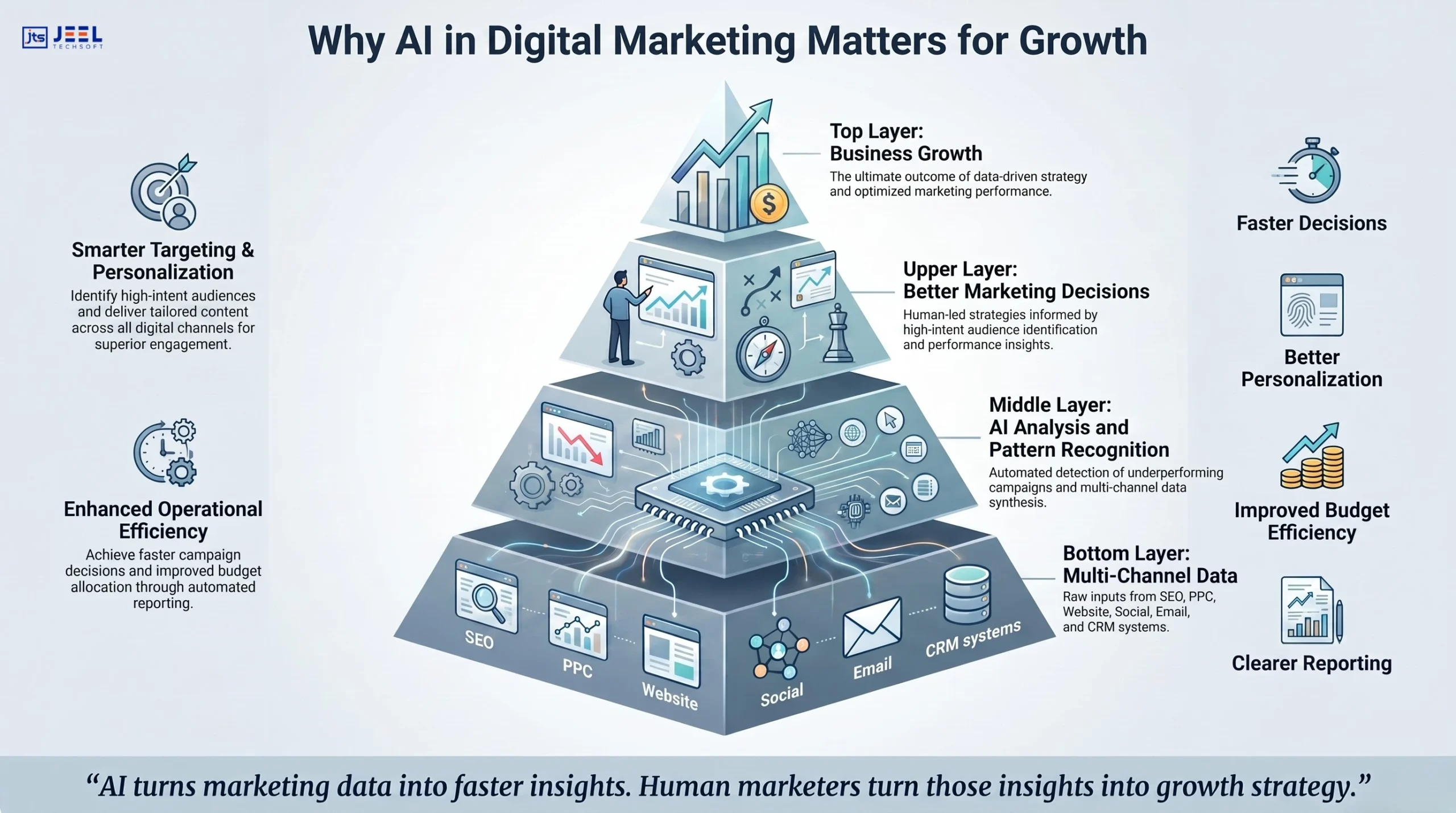
Faster Campaign Decisions
Marketing teams often lose money because they wait too long to act. Poor keywords keep spending. Weak landing pages keep receiving traffic. Low-quality leads keep entering the CRM. Underperforming content stays unchanged.
AI can help spot these issues faster.
For paid ads, it can highlight rising CPC, low-converting search terms, budget leakage, audience fatigue, or landing page mismatch. For SEO, it can surface ranking drops, content decay, indexing issues, and internal linking gaps.
Speed matters, but speed without judgment can create mistakes. A smart agency will not change campaigns just because a dashboard shows movement. It will review the business context first.
Better Personalization Across Marketing Channels
Personalization is one of the strongest use cases for AI in marketing. It helps businesses tailor landing pages, email flows, content recommendations, retargeting campaigns, and offers based on user behavior.
McKinsey’s research points to personalization as a measurable growth driver when companies have clean customer data, decision systems, and clear governance.
For example, a clinic may show different content to patients searching for back pain, sports injury recovery, and posture correction. A SaaS business may create different nurture emails for free-trial users, demo leads, and inactive prospects.
Personalization should feel helpful, not invasive. That is why brand tone, privacy, and customer trust must stay part of the strategy.
Core Services Offered by an AI Digital Marketing Agency
A full-service AI digital marketing agency should cover the major areas that influence online visibility, lead generation, conversion, and reporting. The services may sound familiar, but the process behind them should be sharper, faster, and more data-informed.
AI SEO and Search Optimization
AI SEO is not about producing large volumes of content. It is about making better search decisions.
An agency may use AI-supported workflows for keyword clustering, search intent mapping, competitor gap analysis, internal linking recommendations, content refresh priorities, technical SEO checks, and SERP analysis.
But SEO still needs human expertise. Google’s own guidance emphasizes people-first content, first-hand expertise, helpfulness, page experience, and E-E-A-T signals rather than content created only to attract search traffic.
A strong agency should connect AI SEO with:
- Search intent
- Topic authority
- Technical SEO
- User experience
- Conversion paths
- Local or industry relevance
- Content quality review
AI Content Strategy and Optimization
AI can support content research, topic grouping, brief creation, readability checks, content updates, and performance analysis. But content should never be published without expert review.
The best content answers real customer questions with clarity, proof, and useful examples. It should sound like it comes from a business that understands its market.
For example, a content marketing strategy for a legal firm, healthcare clinic, software company, and ecommerce brand should not follow the same template. The audience, risk level, buying process, and trust signals are different.
An agency should use AI to support content strategy, but human editors should protect accuracy, tone, originality, and brand positioning.
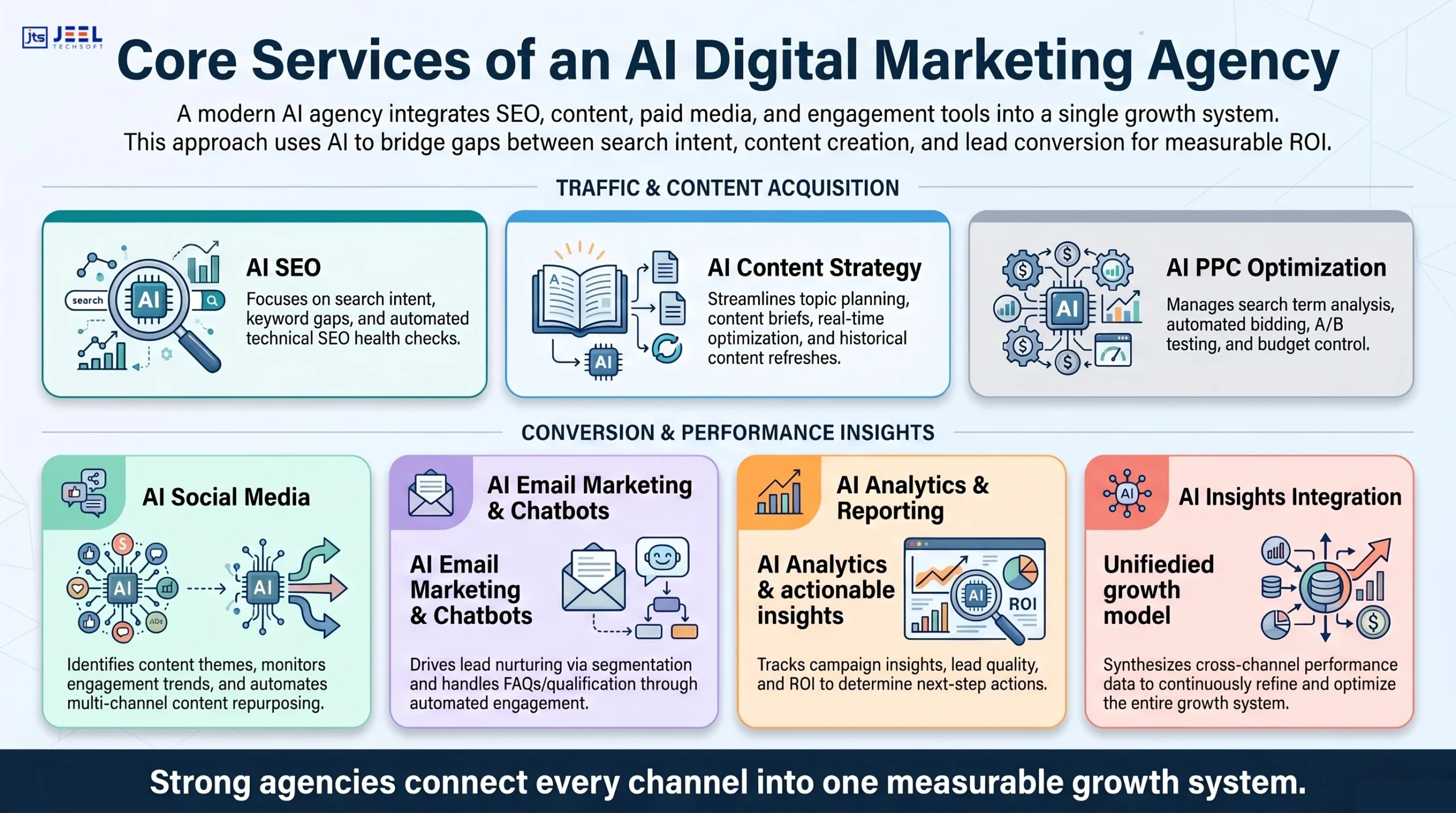
AI Paid Advertising and PPC Optimization
In PPC, AI can help analyze search terms, bid patterns, conversion data, audience behavior, ad fatigue, and landing page performance. It can also support faster testing of ad variations.
But PPC success depends on more than automation. A campaign can have smart bidding and still waste budget if the offer is weak, the landing page is unclear, or the conversion tracking is broken.
A reliable agency should review:
- Campaign structure
- Keyword intent
- Negative keywords
- Conversion tracking
- Landing page quality
- Lead quality
- Budget allocation
- Cost per qualified lead
- Return on ad spend or pipeline contribution
AI Social Media Marketing
AI can help identify content themes, audience behavior, posting patterns, engagement trends, and creative testing ideas. It can also help repurpose long-form content into short-form social posts.
But social media still needs brand taste.
Generic posts do not build trust. A strong agency should help your business create useful, specific, and credible content. For a B2B company, this may include founder insights, case-based posts, industry observations, short videos, and educational carousels. For a local service business, it may include customer questions, service explanations, testimonials, and behind-the-scenes trust builders.
AI Email Marketing and Lead Nurturing
Email marketing is one of the best areas for AI-supported personalization. Agencies can segment leads based on source, interest, behavior, lifecycle stage, and engagement.
For example, a lead who downloaded a pricing guide should not receive the same email as someone who only visited a blog. A returning lead who checked service pages multiple times may need a stronger sales-focused message.
AI can help identify these patterns, but humans should write and review the messaging. Good email marketing feels timely and useful. Poor automation feels cold and repetitive.
AI Analytics and Performance Reporting
Reporting is where many agencies fall short. A monthly report filled with impressions, clicks, and traffic is not enough.
An AI digital marketing agency should help answer:
- Which channels are producing qualified leads?
- Which campaigns are wasting money?
- Which pages influence conversions?
- Which content topics support revenue?
- Which audiences are moving through the funnel?
- What should be changed next month?
AI can help summarize data and detect unusual patterns, but the agency must explain what the numbers mean. Reporting should lead to decisions.
AI Chatbots and Customer Engagement
AI chatbots can support lead qualification, appointment booking, product guidance, FAQs, and customer support. They are useful when visitors need quick answers outside business hours.
But chatbots should be trained carefully. A bad chatbot can frustrate users, give inaccurate answers, or push people away from contacting your team.
A good agency will plan chatbot flows around real customer questions. It will also define when the chatbot should hand the conversation to a human.
How to Use AI in Digital Marketing the Right Way
The right way to use AI in digital marketing is to begin with strategy, not software. Tools should support the plan. They should not become the plan.
Start with Clear Business Goals
Before using AI, define the business outcome.
Do you want more qualified leads? Lower cost per lead? Better SEO visibility? Higher ecommerce conversion rates? More repeat purchases? Stronger email engagement? Cleaner reporting?
Each goal needs different data and different execution.
For example, if your goal is lead quality, the agency should not only optimize for form submissions. It should track which leads become sales opportunities. If your goal is SEO growth, the agency should not only publish blogs. It should improve topical authority, internal linking, technical health, and conversion paths.
Use AI for Research Automation and Insights
AI is useful for research-heavy marketing work. It can speed up competitor analysis, keyword grouping, audience research, content audits, PPC search term reviews, and reporting summaries.
But research is only valuable when it leads to action.
An agency should move from insight to execution:
- What did we learn?
- Why does it matter?
- What will we change?
- How will we measure the change?
This keeps AI from becoming another dashboard that nobody uses.
Keep the Human Strategy and Review Under Control
Google’s guidance makes it clear that content quality, originality, helpfulness, and E-E-A-T matter more than how content is produced. It also warns against automation used mainly to manipulate search rankings.
That is why human review is essential.
AI can draft, analyze, cluster, summarize, and recommend. Humans must decide, edit, validate, and take responsibility for the final output.
This is especially important for industries where trust matters: healthcare, finance, legal services, real estate, SaaS, education, and B2B consulting.
Will AI replace Digital Marketers?
This is one of the most common questions business owners ask: will AI replace digital marketers?
The honest answer is no, not fully. But it will change what marketers do.
AI will reduce time spent on repetitive tasks. It will also raise the standard for speed, analysis, and personalization. Marketers who only execute basic tasks may face pressure. Marketers who understand strategy, customers, positioning, analytics, creative direction, and revenue will become more valuable.
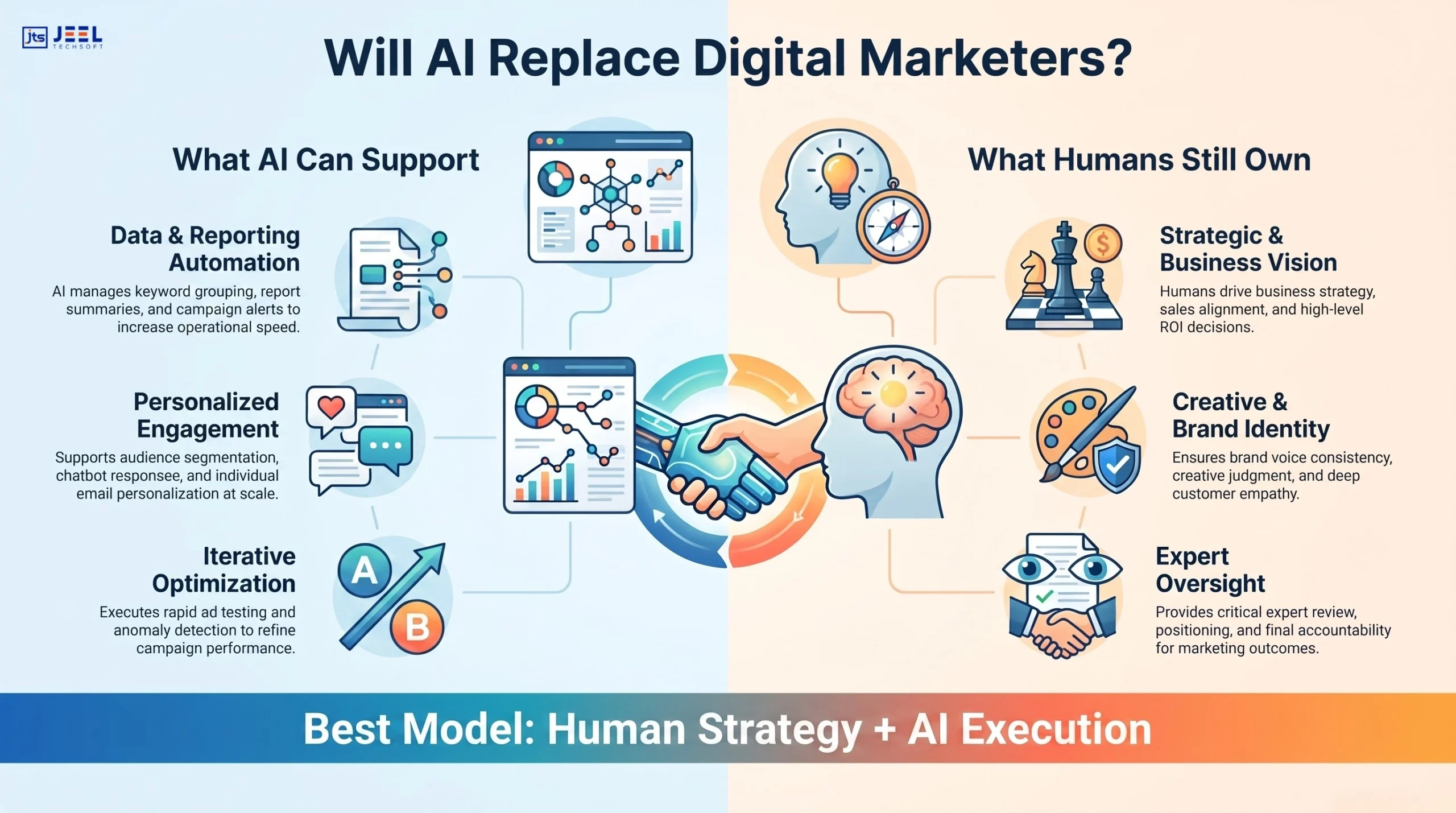
What AI Can Automate
AI can automate or support many repetitive marketing tasks, including:
- Keyword grouping
- Report summaries
- Basic content briefs
- Audience segmentation
- Ad variation testing
- Email personalization
- Data cleanup support
- Chatbot responses
- Campaign anomaly detection
- Social content repurposing
This helps agencies move faster and spend more time on strategy.
What AI Cannot Replace
AI cannot replace business judgment, market understanding, emotional intelligence, creative taste, brand nuance, customer empathy, or accountability.
It also cannot attend your sales calls, understand internal politics, evaluate real customer objections, or know when a campaign technically looks good but commercially performs poorly.
This is why “Can AI replace digital marketing?” is the wrong framing. AI can replace some tasks, but it cannot replace the full marketing function.
Why is human plus AI the Better Marketing Model
The better model is human plus AI.
AI improves speed and pattern recognition. Humans provide direction, context, creativity, and quality control. HubSpot’s 2026 marketing report also emphasizes that while AI is now common in marketing workflows, trust, brand point of view, and human-led marketing remain critical differentiators.
For business owners, this means you should not ask an agency only, “Which AI tools do you use?”
Ask, “How do your strategists use AI to make better decisions for our business?”
How to choose the Right AI Digital Marketing Agency
Choosing the right AI digital marketing agency requires looking beyond presentations, tool names, and buzzwords. The agency should be able to explain how its process improves outcomes.
Check their Strategy Before their Tools
Tools are easy to list. Strategy is harder to prove.
Ask the agency how it will understand your business model, target audience, competitors, sales cycle, conversion points, and current marketing performance.
A strong agency should ask about:
- Revenue goals
- Lead quality
- Customer segments
- Sales process
- Average deal size
- Marketing history
- Tracking setup
- Website performance
- Current challenges
If the agency starts with tools before understanding your business, that is a warning sign.
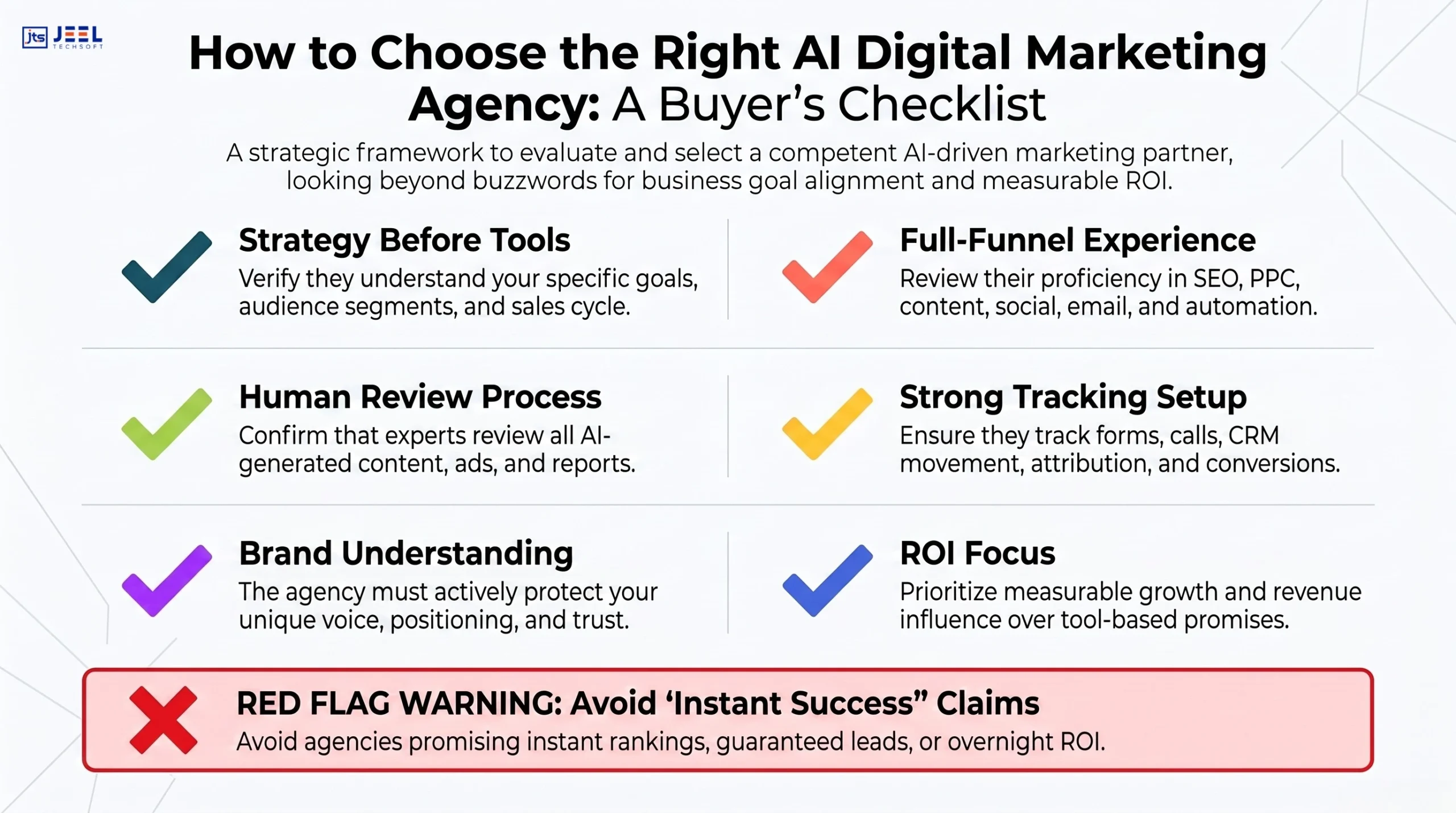
Review their experience across SEO Ads, Content and Automation
AI digital marketing works best when channels are connected.
SEO informs content. PPC reveals high-intent keywords. Social media builds brand recall. Email nurtures leads. Analytics shows what is working. Automation helps scale what is repeatable.
Choose an agency that understands the full funnel, not just one channel.
For example, a PPC agency may reduce cost per click, but if the landing page is weak, conversions may not improve. An SEO agency may increase traffic, but if the content does not match buyer intent, leads may stay flat.
A growth partner should see the whole system.
Ask About Data Tracking And Reporting
Data quality is one of the biggest differences between average and strong agencies.
Before hiring, ask how they track:
- Form submissions
- Calls
- Demo requests
- Ecommerce purchases
- Lead source
- Campaign attribution
- CRM movement
- Cost per qualified lead
- Revenue influence
If tracking is incomplete, AI insights will be unreliable. Poor data leads to poor decisions.
Look For Human Review And Brand Understanding
A good agency should protect your brand voice. It should not publish generic content or run campaigns that sound disconnected from your business.
Ask who reviews content, ad copy, landing pages, email campaigns, chatbot responses, and reports.
Human review should cover:
- Accuracy
- Tone
- Brand fit
- Search intent
- Conversion clarity
- Compliance concerns
- Customer relevance
This is especially important when using AI content strategy and automation.
Check Their Ability To Connect AI With ROI
AI should not be treated as a vanity feature. It should support measurable business growth.
Ask how the agency connects AI-driven work with ROI. The answer may include better campaign efficiency, improved lead quality, faster testing, stronger personalization, reduced manual reporting time, or better conversion insights.
Avoid agencies that promise instant rankings, guaranteed leads, or overnight ROI. Marketing performance depends on competition, website quality, budget, offer strength, sales process, and execution consistency.
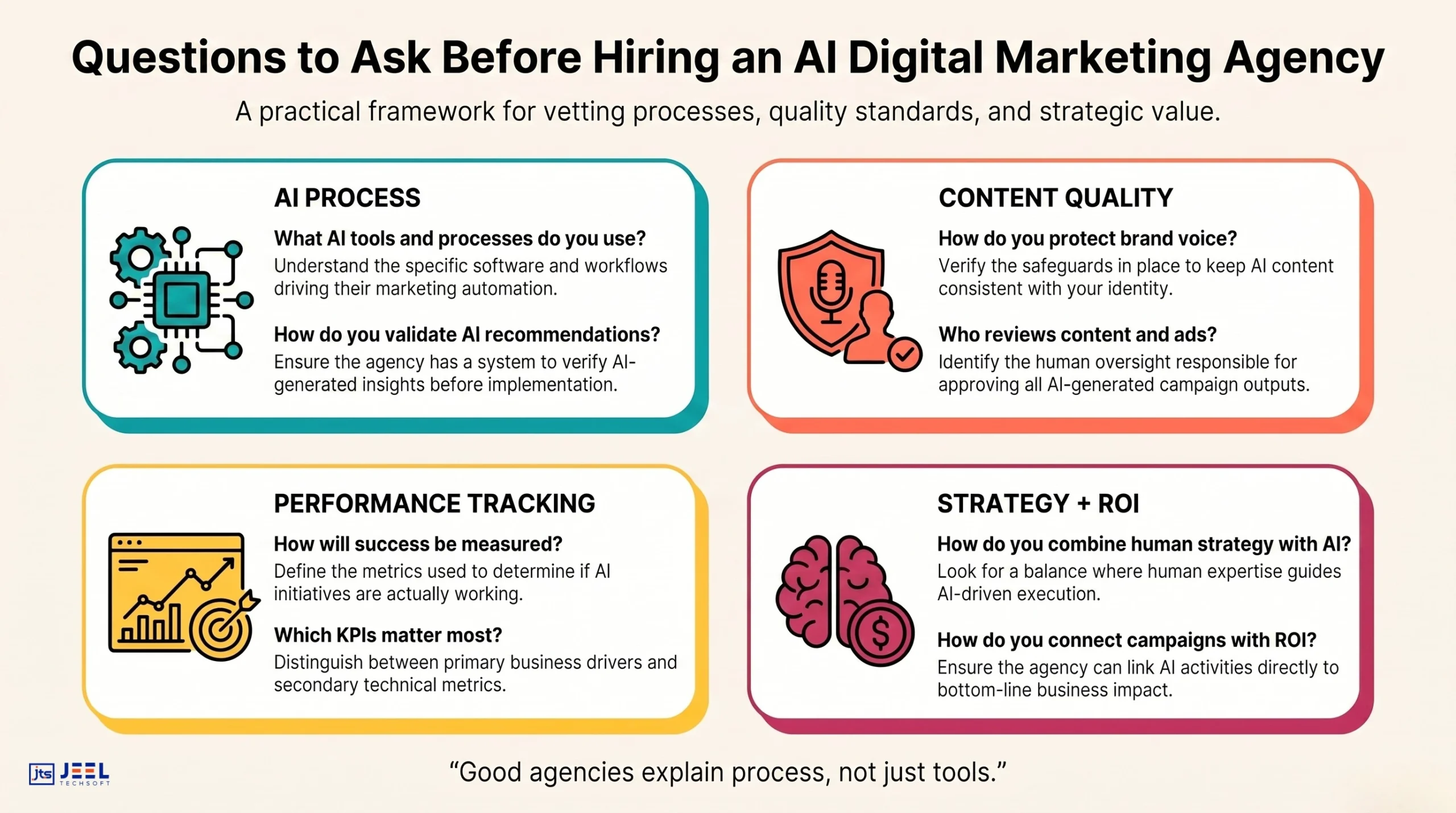
Questions To Ask Before Hiring an AI Digital Marketing Agency
Before signing with an agency, ask practical questions. The answers will show whether the agency has a real process or just a sales pitch.
What AI Tools And Processes Do You Use
Do not stop at tool names. Ask how the tools are used.
Better questions include:
- How do you use AI for SEO research?
- How do you use AI in PPC optimization?
- How do you validate AI recommendations?
- Which tasks are automated and which need human approval?
- How do you prevent low-quality output?
You want to understand the workflow, not just the software.
How Do You Protect Brand Voice And Content Quality
Ask the agency how it learns your brand voice, reviews content, and checks accuracy.
A serious agency should use brand guidelines, editorial review, subject matter input, competitor positioning, customer research, and performance data. It should also have a process for updating content when services, pricing, market trends, or customer needs change.
How Will You Measure Campaign Success
Success should be tied to your business goals.
For some companies, success means a lower cost per qualified lead. For others, it means more organic traffic to service pages, higher demo bookings, stronger ecommerce revenue, more local calls, or better customer retention.
Ask the agency to define primary and secondary KPIs before work begins.
How Do You Combine Human Strategy With AI Execution
This question reveals how mature the agency is.
A weak answer focuses only on faster output. A strong answer explains how strategists set direction, AI supports research and execution, editors review quality, analysts measure performance, and the team improves campaigns based on real results.
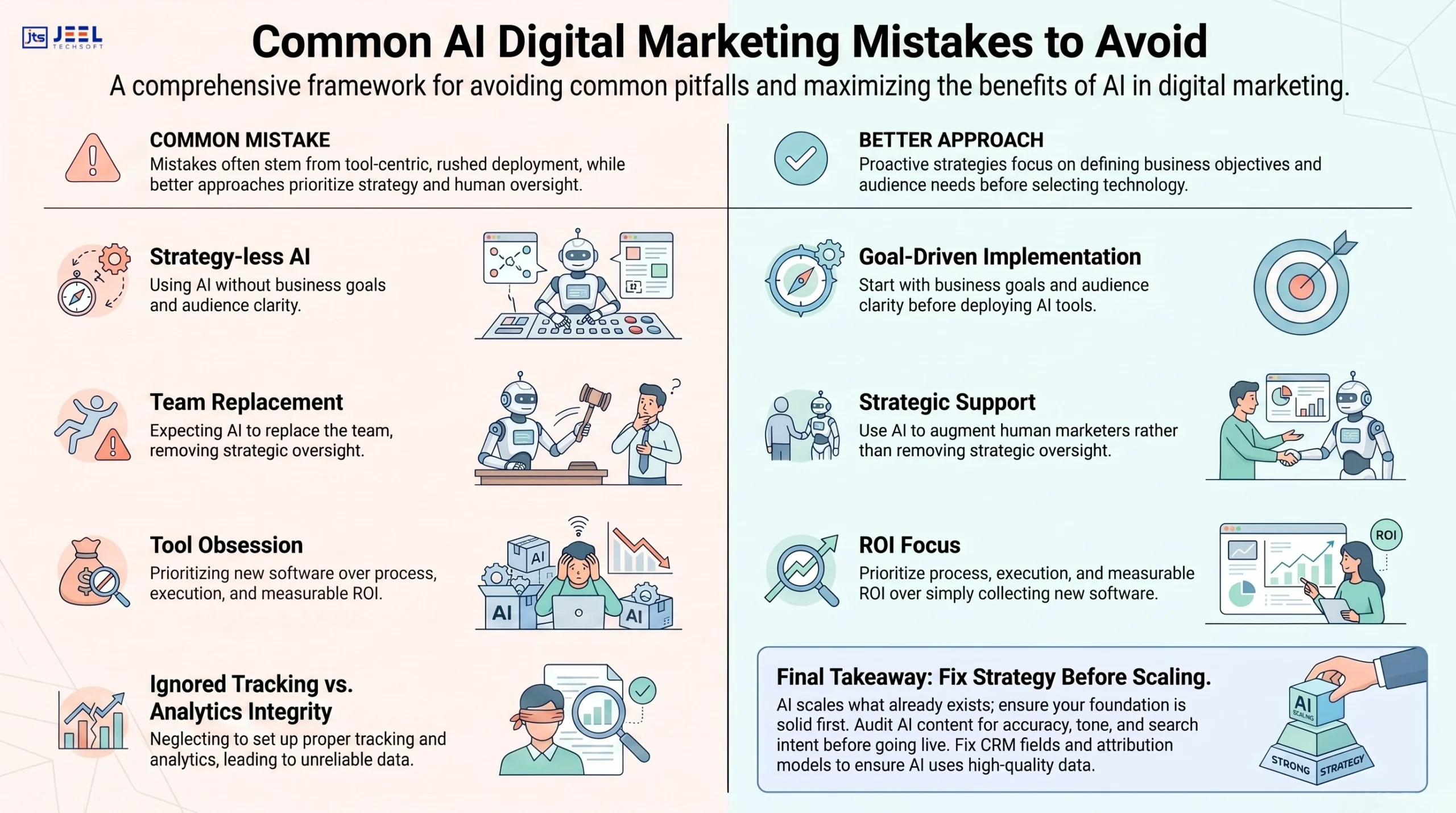
Common Mistakes Businesses Make With AI Digital Marketing
Many businesses adopt AI too quickly without fixing the basics. That creates more activity, but not always better performance.
Using AI Without A Clear Strategy
AI cannot fix unclear positioning, weak offers, poor landing pages, or broken tracking. If your business does not know who it wants to reach and why they should choose you, AI will only scale the confusion.
Start with strategy. Then use AI to improve speed and precision.
Publishing AI Content Without Expert Review
Publishing content without expert review can damage trust. It may sound generic, miss important context, include weak claims, or fail to answer the buyer’s real question.
Content should be reviewed by marketers, editors, and subject matter experts when needed. This protects both SEO performance and brand credibility.
Ignoring Tracking And Data Quality
AI depends on data. If your tracking is wrong, your insights will be wrong.
Before scaling campaigns, check analytics setup, conversion events, call tracking, CRM fields, UTM usage, ecommerce tracking, and reporting dashboards.
Strong data makes better optimization possible.
Expecting AI to Replace The Entire Marketing Team
AI can support the team. It should not become the team.
Businesses still need strategy, messaging, design judgment, customer understanding, sales alignment, technical implementation, and performance review. AI can reduce manual work, but it cannot own the outcome.