
Online shopping has traditionally depended on customers visiting a storefront, browsing categories, opening product pages and completing checkout themselves. That journey is beginning to change. Shoppers can now describe what they need to a software assistant and expect it to research products, compare sellers, check restrictions and prepare a purchase.
A customer may ask for “a waterproof hiking jacket under £180, available in medium, suitable for winter and deliverable before Friday.” Instead of returning a list of blue links, an AI shopping agent can translate that request into product requirements, search merchant catalogues and remove options that do not satisfy the stated conditions.
This shift creates an important commercial question. Can an online store provide sufficiently accurate and dependable information for an external system to represent its products correctly?
That question sits at the centre of agentic commerce. Retailers that prepare early may gain access to new product-discovery and transaction channels. Those relying on incomplete attributes, delayed inventory updates or fragile checkout processes may struggle to appear in agent-generated recommendations, even when their products are competitively priced.
What Agentic Commerce Means for Online Retailers in 2026
A practical definition of agentic commerce
Agentic commerce is an ecommerce model in which a software agent carries out one or more shopping tasks on behalf of a customer. The agent works towards a defined outcome instead of merely answering a question.
The customer provides the objective, preferences and boundaries. The agent then interprets those instructions, gathers product information, evaluates available choices and takes permitted actions. Depending on the level of authority granted, those actions may include saving products, building a cart, requesting approval or initiating payment.
Consider a business owner who needs ten ergonomic office chairs under a fixed procurement budget. A basic shopping assistant might suggest popular chair models. An agentic system could filter products by quantity, warranty, delivery location, assembly requirements and total landed cost. It could then prepare a compliant order for approval.
The important distinction is controlled action. The agent is not simply generating persuasive text. It is using commercial data and transactional tools to complete part of the buying process.
Why agentic commerce is more than another ecommerce trend
Many ecommerce trends affect only the visible storefront. Agentic commerce reaches further into product information management, inventory, pricing, payments, identity, fraud prevention and order handling.
An attractive product page may persuade a human customer even when some technical details are missing. An agent works differently. It may reject a product because the merchant has not clearly stated its dimensions, compatibility, stock status or delivery conditions.
The commercial impact therefore extends beyond installing a new interface. Retailers may need to improve the systems that sit behind the interface.
The Universal Commerce Protocol, for example, is designed to support product discovery, cart building, identity linking, checkout and order management between commerce systems and shopping agents.
Shopify has also documented agent tools that can search catalogues, create carts, start checkout sessions and retrieve order information. These developments indicate that agent-led transactions are moving into practical commerce infrastructure rather than remaining a conceptual experiment.
Agentic commerce, conversational commerce and traditional ecommerce
These models can exist together, but they do not provide the same capabilities.
Commerce model | Customer experience | System capability | Typical outcome |
Traditional ecommerce | Customer browses pages manually | Search, filters, cart and checkout | Customer completes every step |
Conversational commerce | Customer asks questions through chat | Recommendations and support responses | Customer receives guidance |
Agentic ecommerce | Customer defines a goal and constraints | Product retrieval, comparison, cart actions and authorised checkout | Agent completes permitted tasks |
Conversational commerce is useful for answering questions such as “Which laptop is better for graphic design?” Agentic ecommerce goes further by identifying suitable laptops, confirming that the required configuration is in stock, calculating the final cost and preparing the selected product for purchase.
Retailers should not treat these models as replacements for one another. Human-readable pages will remain important. The additional requirement is to make the same commercial information dependable for machine-assisted shopping journeys.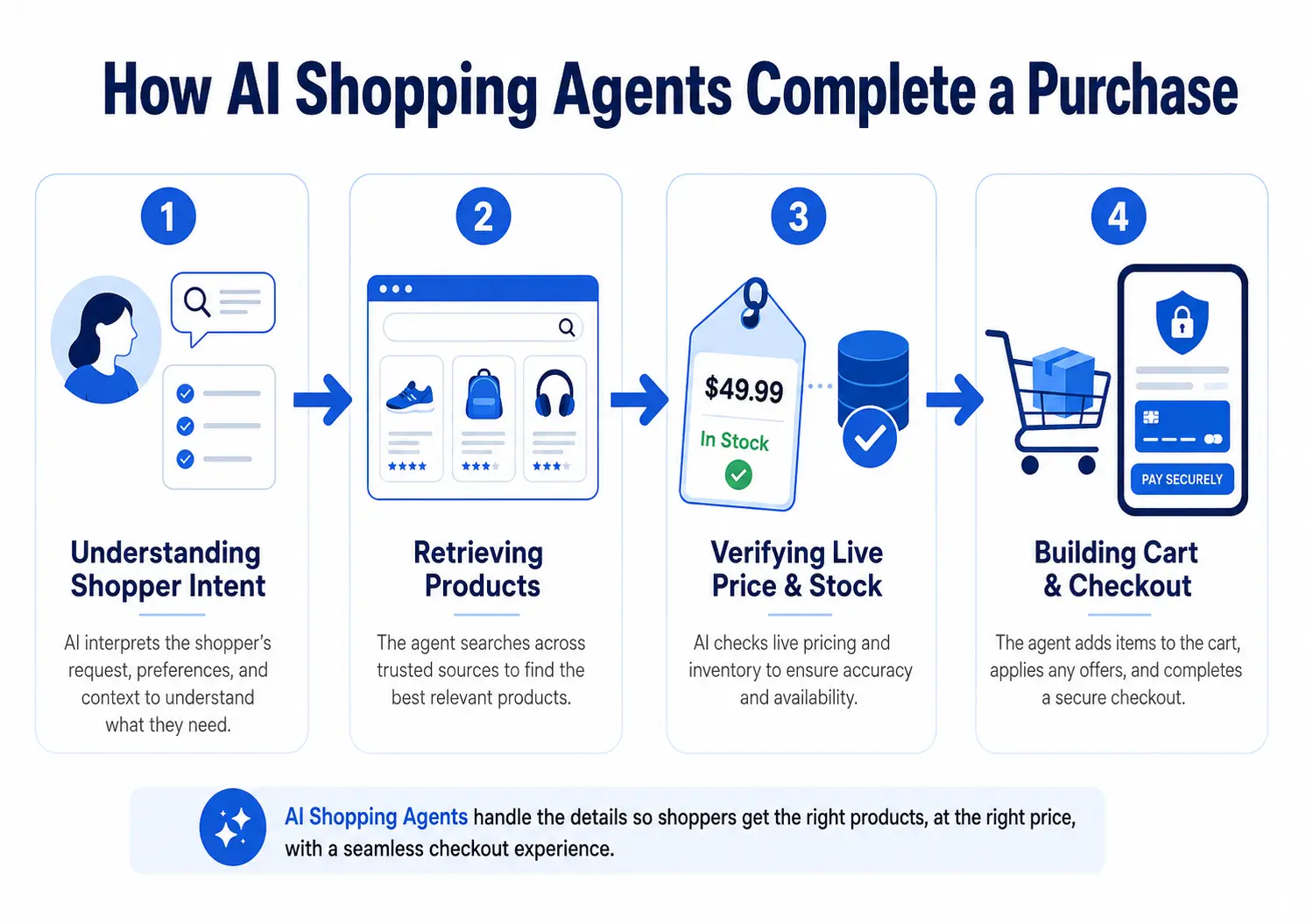
How AI Shopping Agents Find, Compare and Purchase Products
Step 1: Understanding the shopper’s intent
An agent first converts the customer’s natural-language request into structured buying criteria.
A request such as “Find a safe child car seat for a three-year-old under ₹20,000” may contain several explicit and implied requirements:
- Appropriate age, height or weight range
- Applicable safety certification
- Vehicle compatibility
- Budget limit
- Delivery destination
- Preferred installation method
- Return or exchange conditions
The agent must also distinguish between firm restrictions and preferences. A maximum budget may be non-negotiable, while colour may be optional.
Stores can support this stage by using clear terminology and complete product attributes. When one product uses “rear-facing capacity” and another buries the same information inside a paragraph, accurate comparison becomes unnecessarily difficult.
Step 2: Retrieving products from merchant systems
After identifying the requirements, the agent needs a reliable method of retrieving relevant products. It may access indexed product pages, shopping feeds, marketplace listings, catalogue APIs or emerging agentic commerce protocols.
Retrieval quality depends on more than keyword matching. The system must connect a general request with the retailer’s product categories, attributes and variants.
Suppose a customer needs a printer that supports automatic duplex printing and A3 paper. If those properties exist only inside a PDF manual, the product may never enter the shortlist. When the same information is available through structured fields, the agent can evaluate it directly.
OpenAI’s merchant guidance similarly asks participating retailers to provide current catalogue information such as product titles, descriptions, images, prices and availability through a documented feed or API integration.
Retrieval is also where comparison begins. The agent may rank products according to suitability rather than general popularity. A lower-priced product could be excluded because it lacks an essential specification, while a slightly more expensive option may rank first because it satisfies every stated requirement.
Step 3: Verifying live commercial information
Product discovery data is not always transaction-ready data. Before finalising a recommendation, the agent should verify the exact variant, current price, inventory status, shipping eligibility, delivery estimate, tax treatment and return conditions.
This validation step is essential because product pages, advertising feeds and internal inventory systems may update at different times. An item shown as available in search results may already be sold out at the fulfilment location serving the customer.
The agent should therefore request a fresh commercial quote before presenting the final order. That response should include:
- Exact SKU or variant identifier
- Quantity available for purchase
- Current unit price and currency
- Applicable discount conditions
- Tax and shipping charges
- Estimated delivery window
- Quote expiry time
- Purchase restrictions
A recommendation should never be treated as a guaranteed offer when the underlying commercial data has not been revalidated.
Step 4: Building the cart and completing the purchase
Once the customer selects an option, the agent can create or update a cart using the exact product variant. It must preserve the shopper’s original conditions while resolving shipping, address, promotion and payment requirements.
The cart should not silently substitute a different colour, capacity, pack size or seller. Even a technically similar product may violate the customer’s instructions.
Shopify’s agent checkout documentation uses checkout states and merchant hand-off mechanisms, allowing an agent to prepare the transaction and send the buyer to the merchant when further action is required. WooCommerce’s Store API also provides cart and checkout endpoints protected by cart or nonce tokens. Adobe Commerce supports cart creation, product additions and order placement through GraphQL.
For most retailers, the safest early model is assisted completion. The agent performs research and cart preparation, while the customer confirms the final product, amount, address and payment.
AI Shopping Agents vs Ecommerce Chatbots
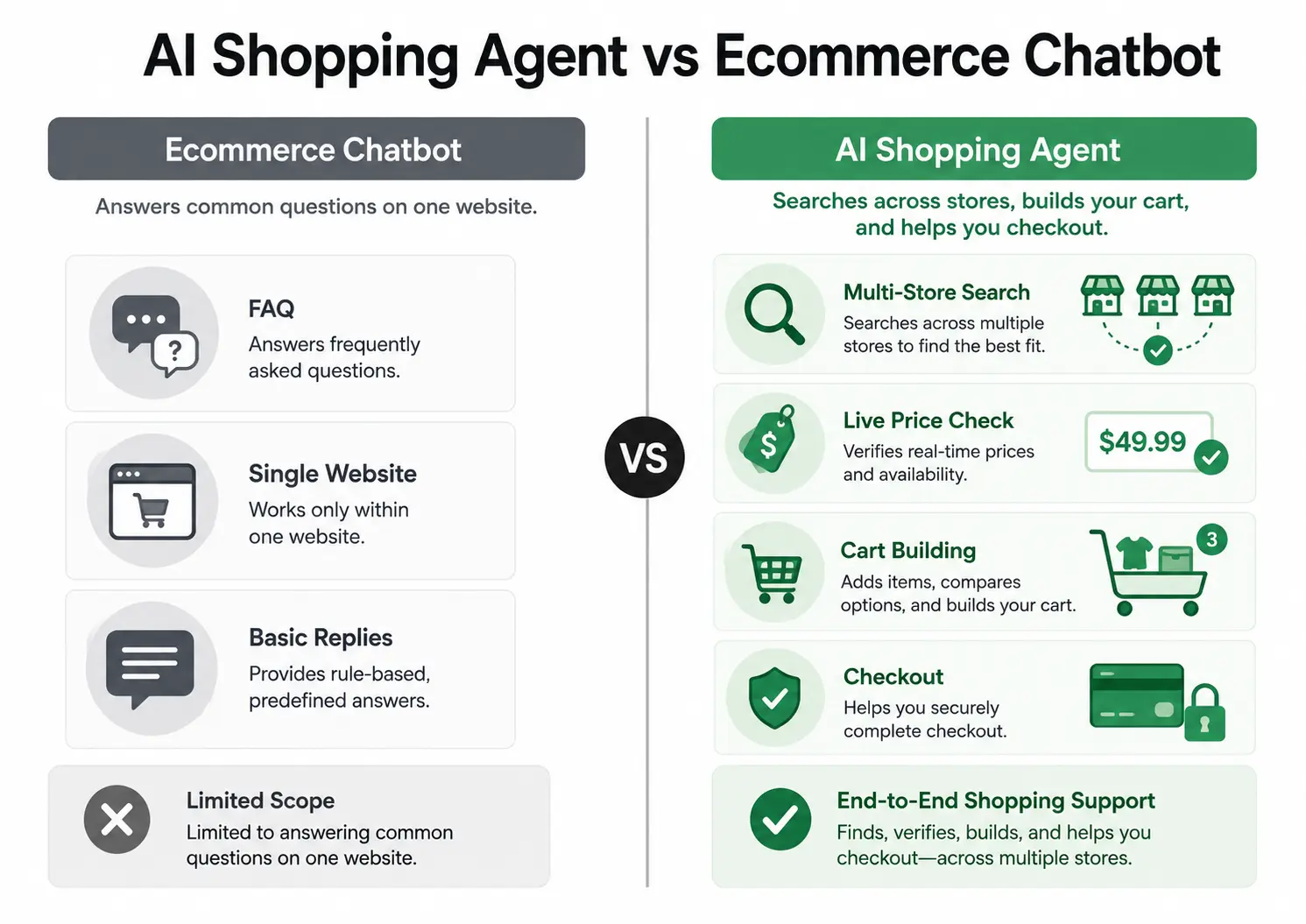
An ecommerce chatbot generally operates inside the retailer’s website. It answers frequently asked questions, suggests products or directs customers to relevant pages.
AI shopping agents may operate outside the merchant’s storefront. They can compare products from several retailers, interact with commerce systems and maintain a shopping objective across multiple steps.
The practical differences are significant.
Capability | Ecommerce chatbot | AI shopping agent |
Answers product questions | Yes | Yes |
Searches one merchant catalogue | Usually | Yes |
Compares multiple merchants | Rarely | Frequently |
Checks live stock and price | Sometimes | Required for reliable action |
Builds or modifies carts | Limited | Common capability |
Acts under customer permissions | Usually no | Core requirement |
Initiates an authorised purchase | Rarely | Possible |
Why adding a chatbot does not create an agent-ready store
A chatbot can create the appearance of intelligent commerce without correcting weaknesses in the underlying store.
For example, a chatbot may state that a product is available because it retrieved an outdated product-page description. If the warehouse system shows zero sellable inventory, the recommendation is commercially incorrect.
An agent-ready store requires reliable connections between the catalogue, product information system, inventory platform, pricing engine, checkout and payment provider. The conversational layer is only one component.
Retailers should therefore avoid evaluating readiness by asking, “Do we have a chatbot?” The more useful questions are:
- Can an authorised system retrieve complete product details?
- Can it identify the correct variant?
- Can it obtain a fresh price and inventory response?
- Can it create a cart without bypassing business rules?
- Can the store verify the agent and customer’s authority?
- Can every important action be audited later?
Why Product Data Will Determine Agentic Commerce Visibility
Agents need facts rather than persuasive product copy
Product storytelling remains valuable for human customers, but agents need unambiguous facts.
“Built for uncompromising performance” does not explain processor speed, load capacity or compatibility. “Designed for every adventure” does not confirm whether a jacket is waterproof, water-resistant or merely windproof.
Effective product content should combine persuasive language with structured factual information.
For example:
Weak description:
A premium lightweight jacket designed for unpredictable weather.
Agent-ready description:
Men’s lightweight shell jacket with a 20,000 mm waterproof rating, taped seams, adjustable hood, two external pockets and a packed weight of 420 grams.
The second version gives a shopping agent measurable criteria that it can compare against the user’s request.
Product attributes must be specific and consistent
Attribute consistency affects whether products can be compared accurately. The same concept should not appear under several unrelated names across categories, feeds and APIs.
A retailer selling electronics might use “storage,” “memory size,” “drive capacity” and “SSD space” for the same property. Human customers may understand the context, but inconsistent naming creates mapping problems for automated systems.
Create an approved attribute dictionary covering:
- Attribute name
- Definition
- Permitted values
- Measurement unit
- Applicable categories
- Required or optional status
- Source system
- Update ownership
Units also matter. A product should not use centimetres on the page, millimetres in the feed and inches in the API without predictable conversion rules.
Variant-level information cannot be hidden
Many purchase errors happen because the parent product appears available while the selected variant is not.
Each size, colour, storage capacity, material, bundle or configuration should have its own identifier and commercial information. At minimum, the store should expose:
- Variant SKU
- GTIN or another recognised identifier where available
- Variant name
- Price
- Availability
- Images
- Dimensions or specifications
- Fulfilment restrictions
- Canonical product relationship
Google’s product-variant structured data guidance supports representing related variants through ProductGroup and individual Product entities. This approach makes the relationship between a parent product and its purchasable options more explicit.
Structured Data, Feeds and APIs Required for AI-Accessible Stores
Implement complete product structured data
Product structured data helps search systems understand the commercial information presented on a product page. For purchasable products, relevant properties can include name, image, description, SKU, brand, price, availability, shipping details and return policies.
Google distinguishes between product snippets and merchant listings. Merchant listing markup supports more detailed ecommerce information for pages where customers can purchase the product.
The markup must agree with the visible page. Adding an InStock value while the page displays “currently unavailable” creates a conflict rather than an advantage.
Retailers should validate structured data during deployment and monitor errors after catalogue changes. Templates must also handle variants correctly instead of applying the parent product’s price and availability to every option.
Maintain accurate merchant feeds
Merchant feeds remain important because they provide product-discovery platforms with structured catalogue information at scale.
A useful feed should include current values for:
- Product and variant identifiers
- Title and description
- Product URL
- Image URL
- Brand
- Category
- Price and sale price
- Stock availability
- Condition
- Shipping information
- Regional eligibility
Feeds should refresh according to the speed at which commercial information changes. A retailer updating stock every few minutes should not rely on a feed generated once per day.
Google recommends using both on-page structured data and Merchant Center feeds where appropriate because the two sources can support more complete product understanding and verification.
Expose product information through controlled APIs
Structured data and feeds are effective for discovery, but transactional journeys often require APIs.
A controlled commerce API can let an approved agent search products, retrieve variants, request a live quote, create a cart and check order status. The API should expose only the capabilities required for the journey.
A practical API structure may include:
- GET /products
- GET /products/{id}
- GET /variants/{id}
- POST /quotes
- POST /carts
- POST /carts/{id}/items
- POST /checkout-sessions
- GET /orders/{id}
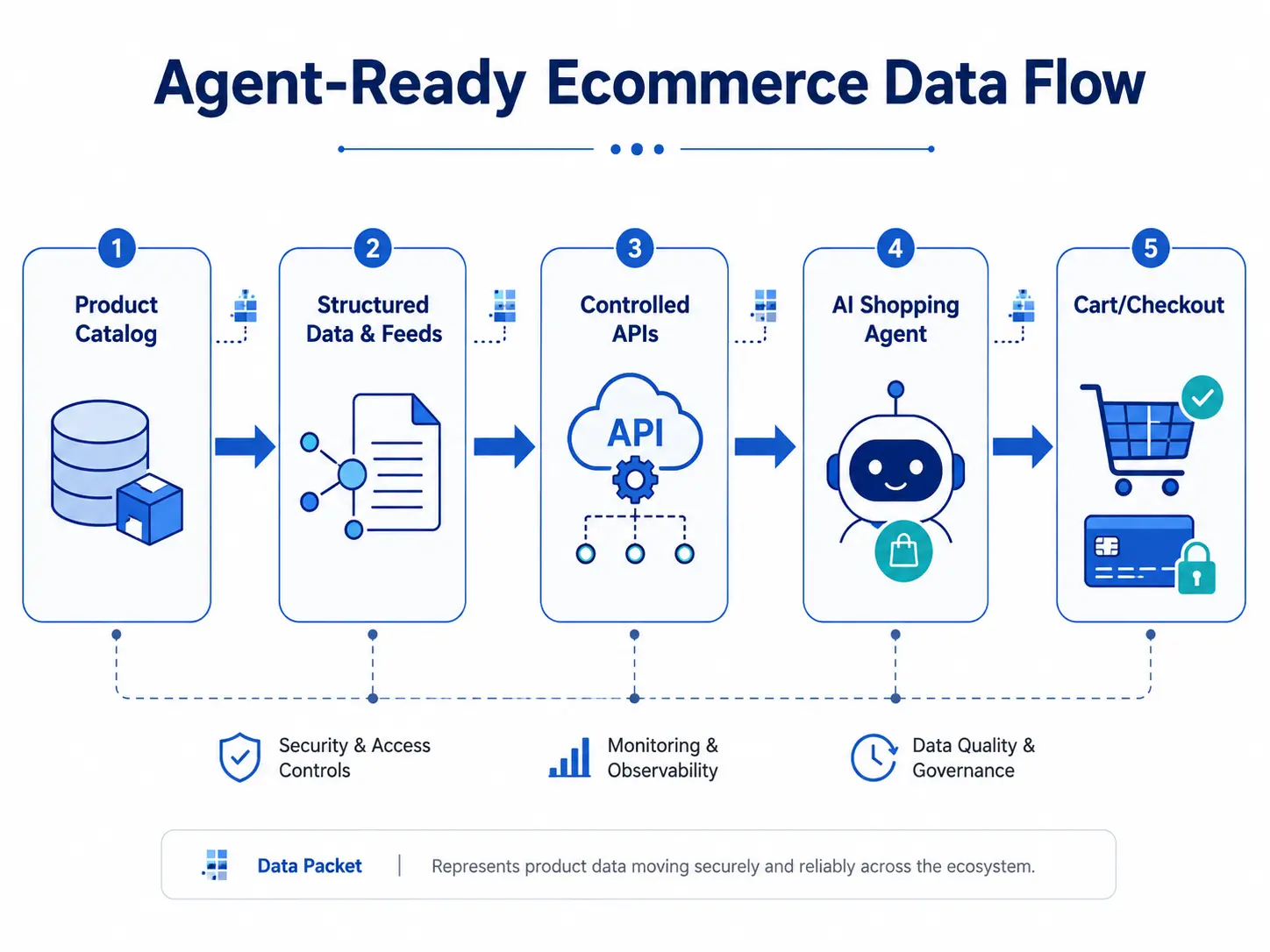
Each response should use stable field definitions, clear error messages and versioned schemas. A team providing custom eCommerce development should treat these API contracts as part of the commerce architecture rather than a temporary integration layer.
Understand emerging commerce protocols
Retailers should monitor protocols that standardise communication between merchants, agents and payment systems.
The Universal Commerce Protocol supports commerce functions including catalogue search, cart building, identity linking, checkout and order management. Google has documented UCP adoption for agentic actions in AI Mode and Gemini, while Shopify provides agent-facing implementations around its catalogues and checkout services.
OpenAI’s Agentic Commerce Protocol provides another integration route for product discovery and embedded checkout experiences. Its merchant documentation supports catalogue delivery through feeds or APIs and a checkout specification for approved integrations.
Retailers do not need to commit immediately to every protocol. They should build a clean internal commerce service that can map to multiple external standards. This reduces dependence on a single shopping platform.
Protect APIs without blocking legitimate agents
Agent access must not mean unrestricted access.
Use authentication and authorisation controls appropriate to the requested capability. Public product discovery may require limited access, while cart, customer and order functions need stronger identity checks.
Controls may include:
- Auth with narrowly defined scopes
- Signed requests
- Mutual TLS for trusted integrations
- Short-lived access tokens
- Rate limiting
- Behavioural anomaly detection
- Request and response logging
- Data minimisation
- IP and reputation signals
- Separate read and transaction permissions
Visa’s Trusted Agent Protocol is designed to help merchants distinguish approved agents from malicious bots through verifiable identification. This type of agent recognition can complement existing bot-management and fraud systems rather than replace them.
Real-Time Pricing, Availability and Inventory Synchronization
Why stale information creates expensive agent errors
Stale product information is inconvenient when one customer encounters it. It becomes more serious when automated systems repeatedly use it.
Imagine that a popular appliance is out of stock, but an external feed still marks it as available for six hours. Multiple shopping agents could recommend it, create carts or present delivery commitments that the retailer cannot fulfil.
The resulting cost may include failed checkouts, support contacts, order cancellations, refunds and reduced confidence in the merchant.
The correct objective is not merely “update inventory frequently.” It is to define which system holds the authoritative sellable quantity and how quickly every connected channel receives changes.
Connect agents to live commercial data
A retailer may have separate systems for product information, warehouse inventory, store inventory, pricing, promotions and orders. Agent-driven journeys need an orchestration layer that returns a single commercially valid response.
For example, physical stock of 20 units does not always mean 20 units are available online. Some may be reserved for existing orders, damaged, assigned to another region or below a safety threshold.
The response given to an agent should therefore use available-to-promise inventory rather than a raw warehouse count.
Event-driven synchronisation is often suitable for high-volume stores. Changes in price, stock or product status trigger updates to downstream systems. Smaller stores may use frequent scheduled updates, provided they monitor failures and set realistic validity periods.
Handle regional and customer-specific pricing
A product does not always have one universal price.
Final pricing may depend on:
- Customer location
- Currency
- Applicable tax
- Customer group
- Membership status
- Contract terms
- Quantity
- Promotion eligibility
- Delivery method
- Marketplace commission
An agent should not compare a tax-exclusive B2B price from one merchant with a tax-inclusive consumer price from another.
Return a clear pricing context with every quote. Include the currency, customer segment, tax treatment, promotion conditions and expiry time. When the customer’s identity or location is unknown, label the amount as an estimate rather than a guaranteed final price.
Add fallback rules for uncertain information
An agent should not guess when commercial information is incomplete.
Fallback rules can require human confirmation when:
- Inventory cannot be verified
- The price changes beyond an approved tolerance
- Delivery falls outside the requested date
- A requested variant becomes unavailable
- A substitute changes an essential specification
- The final amount exceeds the customer’s limit
- Identity or payment verification fails
A controlled pause is better than an incorrect purchase. Retailers should design uncertainty handling as part of the transaction flow instead of treating every interruption as a technical failure.
Secure AI-Assisted Checkout and Payment Authorization
The central challenge is authorization
The technical ability to submit an order is not the same as permission to make the purchase.
A merchant must be able to determine:
- Which customer issued the instruction
- Which agent is acting
- What actions the customer permitted
- The maximum approved amount
- Whether substitutions were allowed
- How long the permission remains valid
- Whether the final order still matches the mandate
This is why authorization is becoming central to agentic commerce in 2026. The merchant needs evidence that the final transaction reflects the customer’s instructions, not merely evidence that an API request was received.
Keep payment credentials away from the AI model
Raw card numbers, security codes and bank credentials should not pass through the language model.
Payment providers can use tokenisation so the agent receives a limited payment reference rather than the underlying credential. The token may be restricted by merchant, amount, purpose or expiration time.
Stripe’s Shared Payment Tokens are designed to let an agent initiate a payment with customer permission without exposing the customer’s underlying payment credentials. Stripe also documents controls that can scope a token to a seller, time period and amount.
The retailer should continue using its normal payment processor, fraud checks and order-validation logic wherever possible.
Preserve evidence of customer intent
Agentic transactions require a stronger audit trail than a conventional cart session.
Record the following information:
- Original customer instruction
- Extracted purchase constraints
- Selected product and variant
- Alternative products considered
- Changes made after initial approval
- Agent identity
- Customer identity or session
- Pricing and stock validation time
- Approval event
- Payment token reference
- Final order response
Logs should be tamper-resistant and connected through a transaction identifier. This evidence can support customer service, dispute handling, fraud investigation and compliance reviews.
Design a human-in-the-loop checkout process
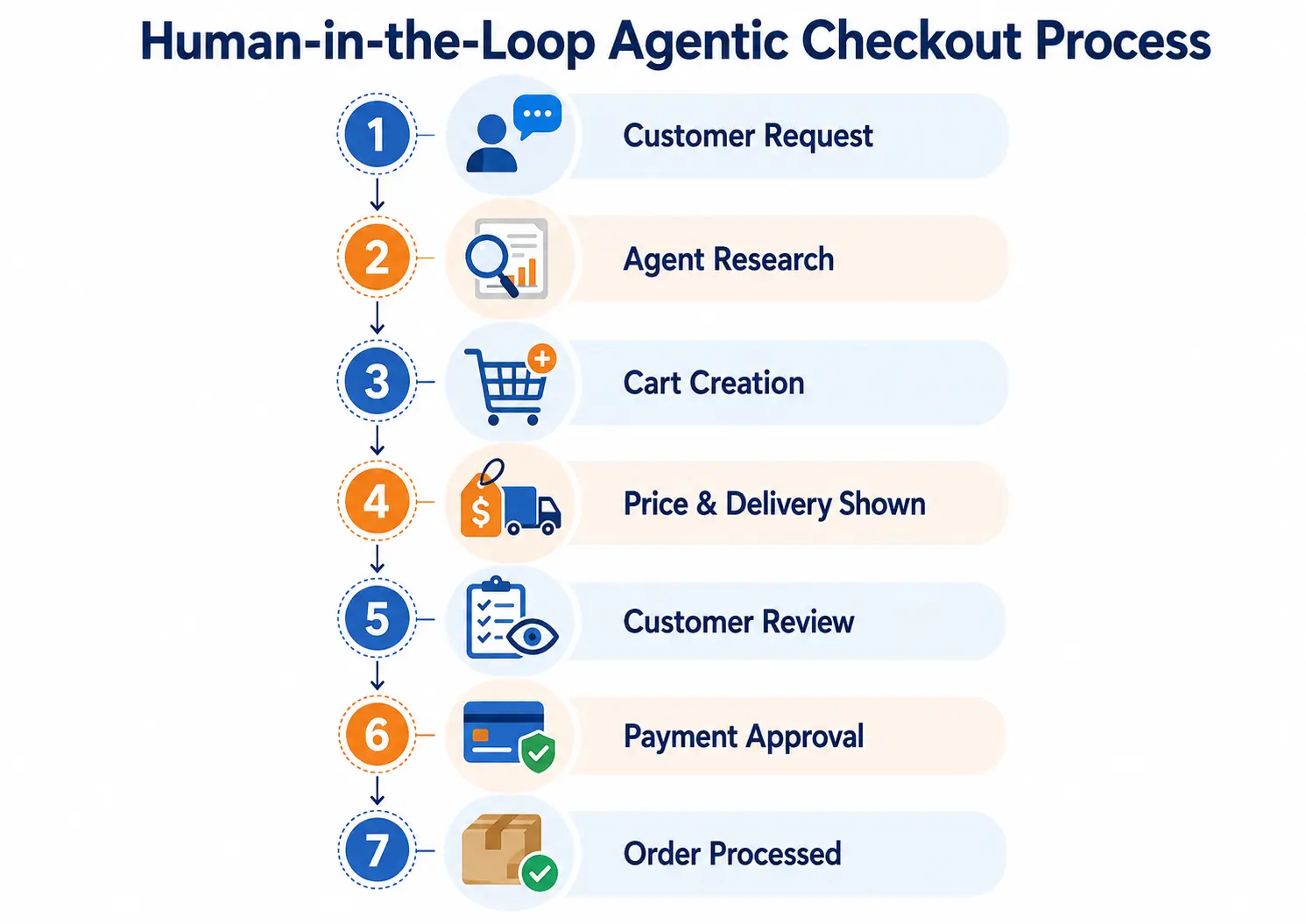
Full autonomy is not necessary for a useful agentic commerce experience.
A safer early workflow may look like this:
- The customer describes the requirement.
- The agent researches and compares products.
- The agent creates a cart.
- The retailer returns the final price and delivery information.
- The customer reviews the order.
- The customer explicitly approves payment.
- The merchant processes the transaction.
Additional confirmation can be required for expensive products, subscriptions, regulated goods, international shipping or significant substitutions.
This model still removes substantial effort from the journey while keeping the customer in control of the final commitment.
Shopify, WooCommerce and Magento Readiness for Agentic Commerce
All three platforms can participate in agentic ecommerce, but their readiness depends on the quality of the merchant’s implementation.
Platform | Existing strengths | Main preparation requirement | Typical difficulty |
Shopify | Managed infrastructure, catalogue tooling and documented agent interfaces | Clean product data, app compatibility and checkout governance | Low to moderate |
WooCommerce | Flexible Store API and large extension ecosystem | Plugin control, API security, caching and data consistency | Moderate |
Magento or Adobe Commerce | Advanced catalogues, B2B pricing, inventory and GraphQL | Integration architecture, performance and governance | Moderate to high |
Shopify readiness
Shopify currently provides the clearest documented path for agent-facing catalogue and checkout capabilities. Its agent documentation covers catalogue discovery, carts, checkout sessions and order monitoring through UCP-compatible tools.
That does not make every Shopify store automatically ready. Merchants still need to review:
- Product and variant completeness
- Metafield consistency
- Third-party inventory integrations
- Subscription and bundle apps
- Regional market settings
- Promotion logic
- Checkout customisations
- Post-purchase workflows
WooCommerce can support similar journeys through its Store API, which includes product, cart and checkout functionality. POST operations require appropriate cart or nonce tokens, and dynamic cart and checkout pages must not be served from inappropriate caches.
Magento Open Source and Adobe Commerce provide GraphQL coverage for product search, carts and checkout. They are well suited to complex catalogues, multiple customer groups and advanced pricing, but implementations often include custom modules and integrations that require detailed testing.
An experienced eCommerce website development company should evaluate the merchant’s complete architecture rather than judging readiness from the platform name alone.
Major Risks of Agentic Ecommerce
Inaccurate or unintended purchases
An agent may select the wrong size, quantity, seller, subscription term, or product configuration. These errors can occur when the original instruction is ambiguous, or merchant data is incomplete.
Reduce the risk by displaying the exact final variant, quantity, total and delivery terms before approval. Material changes should invalidate the previous approval.
Privacy and customer-data exposure
Shopping journeys can involve addresses, order histories, preferences, loyalty data and payment references. Agents should receive only the information required to complete the permitted task.
Public catalogue access must remain separate from authenticated customer data. Retailers should also define retention periods and prevent sensitive information from appearing in model prompts or diagnostic logs.
Fraudulent agents and automated abuse
A malicious system may present itself as a legitimate shopping agent while attempting to scrape prices, reserve inventory, test payment credentials or generate fraudulent orders.
Use agent verification alongside existing fraud controls. Rate limits, transaction thresholds, signed requests, device intelligence and behavioural monitoring remain necessary.
Prompt injection and manipulated product content
A product description, seller message or review could contain text intended to influence an agent’s behaviour.
The agent should treat merchant content as untrusted data. Product text should never override system instructions, authorization conditions or payment controls.
Retailers should also moderate user-generated content and separate descriptive information from executable tool instructions.
Merchant liability and dispute handling
Agentic transactions can create difficult questions when the customer says the agent bought the wrong item.
Policies should define responsibility for incorrect selections, unauthorised substitutions, inaccurate stock information, delivery failures and mandate violations.
The retailer’s support team needs access to the decision and authorization history. A standard order record without agent context may be insufficient to resolve the dispute fairly.
Dependence on third-party AI platforms
A retailer that optimises for only one agent platform may lose access when technical requirements, ranking systems or commercial terms change.
Maintain ownership of product information and customer relationships. Use standard internal APIs, exportable feeds and protocol adapters so the store can connect to multiple discovery and transaction channels.
A Practical Agentic Commerce Implementation Roadmap
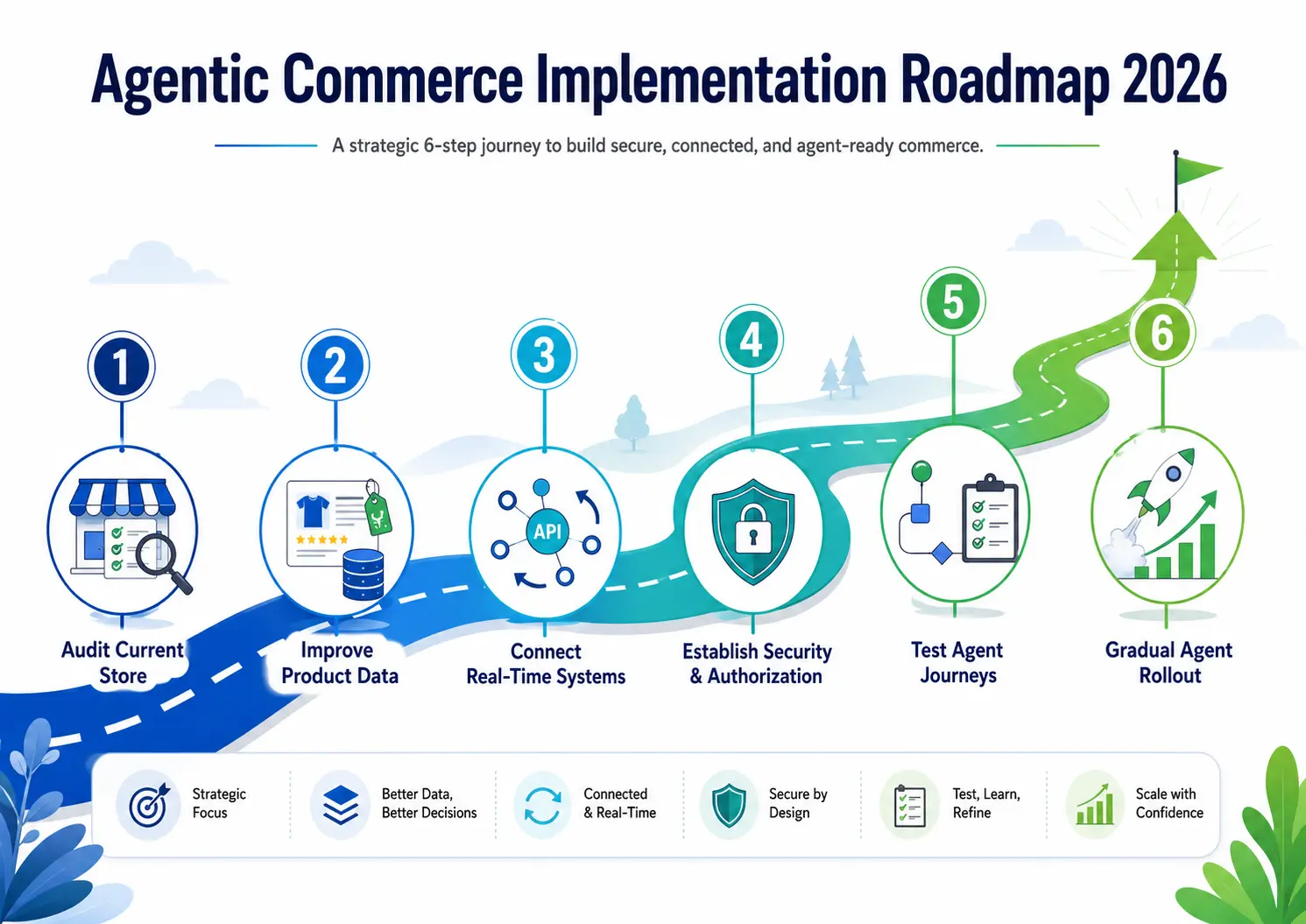
Phase 1: Audit the current store
Document the systems responsible for catalogue data, product attributes, price, stock, promotions, checkout, payments, shipping and orders.
Test whether the page, feed and API return the same information for a sample of important products. Record every inconsistency and identify the authoritative source.
Phase 2: Improve the product-data foundation
Standardise SKUs, variant relationships, category attributes, measurement units and identifiers.
Prioritise products with high revenue, high search demand or frequent support questions. Product-data improvement does not need to begin with the entire catalogue.
Phase 3: Connect real-time commerce systems
Create dependable services for stock, price, delivery and cart totals.
Define acceptable latency and failure behaviour. The agent should receive a clear unavailable or uncertain response rather than outdated information when a dependency fails.
Phase 4: Establish authorization and security controls
Separate discovery permissions from transactional permissions.
Implement identity checks, token scopes, approval limits, request signing, audit logs, fraud rules and incident-response procedures. Review the controls with payment, security, legal and customer-service teams.
Phase 5: Test controlled agent journeys
Create test scenarios covering:
- Exact-product purchases
- Products with several variants
- Out-of-stock items
- Price changes after selection
- Failed promotions
- Address restrictions
- Split shipments
- Payment rejection
- Customer cancellation
- Returns and order-status requests
Testing should assess commercial correctness, not only whether the API returned a successful status code.
Phase 6: Introduce agent access gradually
Start with product discovery and comparison. Add cart creation after product data and inventory responses are dependable. Introduce payment only after authorization, fraud and audit controls have been validated.
A phased release limits financial exposure and gives the team time to understand new customer and agent behaviour.
Agentic Commerce Store-Readiness Checklist for 2026
Readiness area | Required check |
Product identifiers | Every purchasable variant has a stable SKU |
Product attributes | Important specifications use consistent fields and units |
Structured data | Product markup matches visible page information |
Merchant feeds | Price and availability updates are monitored |
Inventory | Agents receive available-to-promise quantities |
Pricing | Quotes include currency, tax context and expiry |
APIs | Endpoints are versioned, documented and access-controlled |
Cart | The exact variant and quantity are preserved |
Authorization | Customer permissions are explicit and bounded |
Payment | Raw credentials never enter the model |
Security | Legitimate agents can be distinguished from abusive bots |
Logging | Customer intent, changes and approval are auditable |
Fallbacks | Uncertain transactions pause for confirmation |
Testing | Error, substitution and cancellation journeys are covered |
Measurement | Agent traffic, conversion, errors and disputes are tracked |
How Retailers Can Measure Agentic Commerce Performance
Traditional ecommerce metrics remain useful, but retailers need additional measurements for agent-led journeys.
Track:
- Agent referral sessions
- Product retrieval success rate
- Percentage of catalogue eligible for agent comparison
- Attribute completeness
- Live quote success
- Price and stock mismatch rate
- Cart creation rate
- Customer approval rate
- Agent-assisted conversion rate
- Transaction failure rate
- Cancellation and return rate
- Fraud-review rate
- Average order value
- Contribution margin
- Support contacts per agentic order
Segment results by agent platform, protocol, product category and transaction type.
A high conversion rate can appear positive while hiding frequent returns or expensive support cases. Evaluate the entire order lifecycle, including fulfilment, customer satisfaction and disputes.
What Online Stores Should Prioritise Now
Retailers do not need to begin with autonomous checkout. The first priority is making the store commercially dependable.
Focus on five areas:
- Complete and consistent variant-level product data.
- Structured markup and feeds that match the storefront.
- Live price, inventory and delivery validation.
- Controlled APIs for product, cart and order functions.
- Explicit authorization and auditable payment processes.
Businesses reviewing eCommerce development services should include these requirements in platform upgrades, headless builds, ERP integrations and checkout projects. Retrofitting them later may be more difficult than including them in the architecture from the beginning.


