
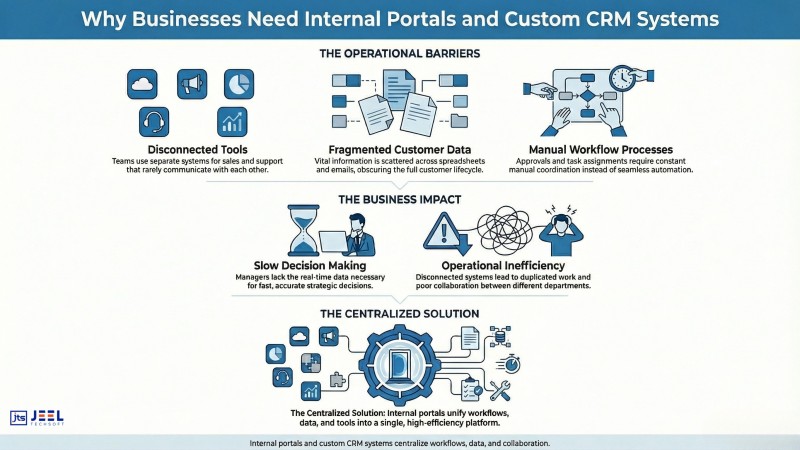
Organizations often struggle with fragmented tools, manual workflows, and disconnected data across departments. Well-designed internal portals and custom CRM platforms can solve these issues, but only when built on a robust framework.
ASP.NET development services provide the scalability, security, and integration capabilities required to create tailored internal systems such as custom crm systems and enterprise workflow management platforms.
With features like role-based access, seamless integration with Microsoft technologies, and strong backend performance, ASP.NET enables companies to build reliable internal applications that improve operational efficiency and decision-making.
Why internal systems fail often
Many companies invest in internal systems expecting productivity gains, yet those systems often fall short. The issue rarely lies in the idea of digital transformation itself; it’s usually the execution.
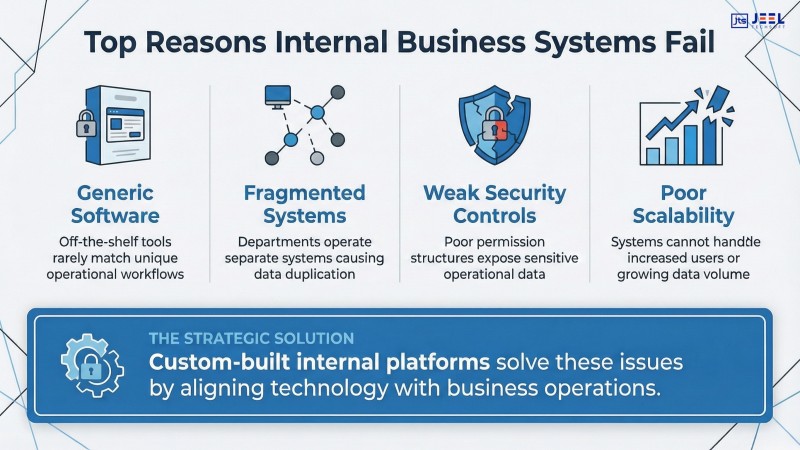
A few common problems explain why internal platforms fail:
1. Generic software that doesn’t fit operations
Off-the-shelf CRM tools are designed for broad use cases. However, businesses frequently require specialized workflows such as multi-stage approvals, department-specific dashboards, or custom reporting structures.
For example:
- A logistics company may require route-based client management.
- A manufacturing firm may need production tracking linked to CRM data.
- A professional services firm may rely on client lifecycle management integrated with project systems.
Generic CRM solutions often struggle to accommodate these needs without heavy customization.
2. Fragmented workflow management
Many teams still operate using separate tools for communication, customer records, and task tracking. This leads to:
- Duplicate data entries
- Inconsistent customer records
- Delayed decision-making
Without centralized workflow management, internal operations become slow and error-prone.
3. Security and permission challenges
Internal portals often contain sensitive operational data. When systems lack structured permission models, employees may gain unnecessary access to confidential information or, worse, critical processes become vulnerable to errors.
4. Lack of scalability
As businesses grow, internal tools must handle:
- More users
- Larger datasets
- Increased automation requirements
Poorly built systems fail to scale, forcing companies to rebuild infrastructure later.
This is why many organizations now turn toward ASP.NET development services to create tailored internal platforms designed specifically for their operational structure.
CRM and portal requirements
An effective internal portal or CRM platform should do more than store customer data. It must serve as the operational backbone of the organization. Several core capabilities define a well-built system.
Unified customer management
At the heart of any CRM lies centralized data. Every customer interaction, from sales inquiries to service requests, should be stored in one place.
A well-designed CRM includes:
- Customer profiles with historical interactions
- Contact management
- Opportunity and lead tracking
- Sales pipeline monitoring
These features allow teams to see the entire customer journey rather than fragmented records.
Integrated workflow management
Workflow automation ensures that business processes move efficiently between teams.
Examples include:
- Automatic lead assignment to sales representatives
- Approval flows for discounts or contracts
- Task reminders for follow-ups
- Escalation systems for support issues
These automated processes eliminate delays and ensure accountability across departments.
Internal collaboration tools
Modern internal portals often combine CRM capabilities with collaborative tools.
Examples:
- Shared dashboards
- Project tracking boards
- Internal announcements
- Document repositories
When employees access these tools from a single portal, collaboration improves significantly.
Real-time reporting and analytics
Managers need actionable insights to guide business decisions. A custom CRM system should provide:
- Performance dashboards
- Sales forecasting
- Department activity reports
- Customer retention metrics
Because these insights come directly from operational data, leadership teams can identify bottlenecks quickly.
Companies seeking these capabilities often rely on CRM development services integrated with frameworks like ASP.NET to build systems tailored to their internal operations.
ASP.NET strengths for internal tools
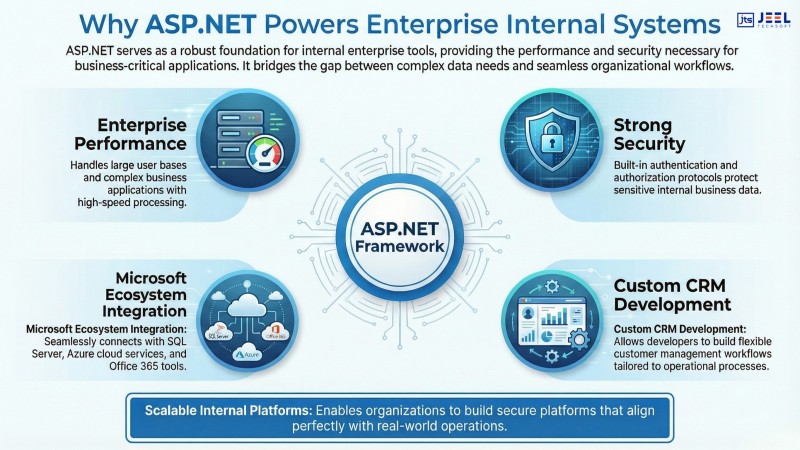
When it comes to building enterprise-grade internal applications, ASP.NET offers several advantages that make it a preferred choice for organizations.
Enterprise-level performance
ASP.NET is built on the .NET Framework, which supports high-performance server applications. It efficiently handles complex logic, large datasets, and concurrent users.
This is particularly important for internal systems such as:
- Customer relationship management platforms
- Workflow automation systems
- Business analytics dashboards
Companies using ASP.NET development services can build systems capable of supporting hundreds or even thousands of employees without performance degradation.
Seamless integration with the Microsoft ecosystem
Many organizations already rely on Microsoft technologies, such as:
- Microsoft SQL Server
- Azure cloud services
- Office 365
- SharePoint
ASP.NET integrates seamlessly with this ecosystem, simplifying development and reducing operational complexity.
For CRM functionality specifically, Microsoft provides extensive resources through its official documentation, including the Microsoft Dynamics 365 developer ecosystem and related tools.
These integrations make ASP.NET particularly effective for companies already operating within Microsoft infrastructure.
Strong security framework
Internal systems often contain sensitive company information, such as:
- Client databases
- Financial reports
- Operational analytics
- Employee records
ASP.NET includes built-in security mechanisms, including:
- Authentication systems
- Authorization controls
- Data protection frameworks
- Secure API integrations
These capabilities make it suitable for enterprise environments where security compliance is critical.
Flexibility for custom CRM systems
Unlike rigid CRM platforms, ASP.NET allows developers to build solutions tailored precisely to business workflows.
Examples include:
- Custom sales pipelines
- Industry-specific client management models
- Automated service ticketing workflows
- Integrated document approval processes
Businesses that invest in web application development using ASP.NET gain systems that evolve alongside their operational needs.
Building role-based access
Role-based access control (RBAC) is one of the most important components of internal portals and CRM platforms.
Without structured access control, internal tools quickly become chaotic and insecure. Role-based access ensures that users see only the information relevant to their responsibilities.
Typical access layers include:
Administrators
- Full access to system configuration
- User permission management
- Workflow setup and reporting dashboards
Managers
- Team performance dashboards
- Sales or operations oversight
- Approval workflows
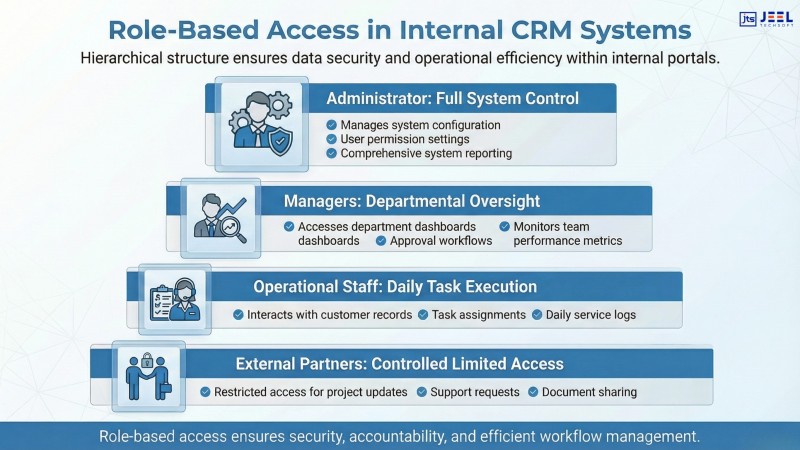
Operational staff
- Task assignments
- Customer interaction logs
- Document uploads
External partners
Some organizations also provide limited portal access to partners or clients for tasks such as:
- Project tracking
- Support requests
- Document sharing
ASP.NET supports RBAC implementation through its identity management framework, allowing developers to define detailed permission structures across the entire application.
This capability ensures that internal portals remain organized, secure, and aligned with the organization’s hierarchy.


