Search visibility has become one of the most decisive factors in business success. Yet, many companies struggle with inconsistent rankings, declining organic traffic, and underperforming digital campaigns. Whether it’s a startup trying to break into a competitive niche or an enterprise managing thousands of pages, the complexity of SEO often overwhelms internal teams.
The challenge isn’t just about knowing SEO-it’s about executing it consistently, adapting to algorithm changes, and scaling efforts without inflating costs. Businesses frequently face a dilemma: invest heavily in an in house SEO team or outsource SEO services to experienced professionals who already have the tools, processes, and expertise in place.
In today’s fast-paced digital ecosystem, making the right decision can directly impact growth, ROI, and market positioning. This guide breaks down everything you need to know about SEO outsourcing—how it works, why it matters, and how to leverage it effectively to build long-term digital success.
What is Search Engine Optimization (SEO) ?
Search engine optimization is a process by which website content is easily available on searching, relevant to user’s needs, and popular among other similar content on the internet, which is attained by modulation and adjustment of the website configuration, popularity, and relatability.
Why should you do SEO?
SEO is now the most important thing for brands to work on. As consumers are now mostly available online, this is an affordable and efficient way to reach the maximum target audience. To make the most of it, you need to understand why you should opt for SEO for your business website. Here are some of the notable points.
SEO improves credibility and trust:
The first impression of your website is enough to build initial confidence and credibility with your visitors. And SEO is the foundation to make it. A neat and clean website that shares necessary information and is easy for the visitor to navigate surely impresses the person. Moreover, Search engines also find it easy to find and crawl through the webpage.
The combination of visitors’ trust and the ease for search engines to explore the website gives the brand a status of authority that people can rely on.
Know your VOC (Voice of Customer):
When you are dealing with an online business, it is imperative to know the customer’s demand. But how do you understand the voice of the customer?
SEO shares the client’s taste in granular details and illuminates the nitty-gritty of the macro market. To be specific, you can find your customer’s intents through
-
Search data
-
SERP analysis
-
AI insights and analytics
SEO improves the Buying cycle:
The most important aspect of a brand is the presence at the right place and at the right time. Your brand must be visible where people want to connect with it. Search engine optimization helps to improve your brand’s visibility to the appropriate place where you actually want to get noticed and provides the solution to the customers.
SEO is an investment, not an expenditure:
Search Engine Optimization (SEO) will cost you initially. But this is true for every business asset. In the long term, SEO can help you to grow your business by multifold and save you a lot of money. It is your investment that works as the backend of the front face of your business and continuously boosts its presence, visibility, searchability, and attractive features.
What is SEO Outsourcing?
SEO outsourcing refers to delegating your search engine optimization tasks to an external seo outsourcing company or seo outsourcing agency. Instead of managing everything internally, businesses rely on specialized experts to handle:
-
Keyword research and strategy
-
Technical SEO improvements
-
Content optimization
-
Link building campaigns
-
Performance tracking and analytics
These services are typically delivered by agencies, freelancers, or offshore teams offering outsourced search engine optimization services tailored to business goals.
SEO In-House vs Outsourcing
Here’s a clear comparison table for SEO In-House vs Outsourcing, making it easier to evaluate the right approach for your business:
|
Lower hiring risk, but it depends on partner reliability |
In-House SEO |
Outsource SEO Services |
|---|---|---|
|
Control |
Full control over strategy, execution, and priorities |
Limited direct control but guided by agreed strategy and KPIs |
|
Expertise |
Depends on internal team skills |
Access to specialized experts across multiple SEO domains |
|
Cost Structure |
High fixed costs (salaries, tools, training) |
Flexible pricing (retainer, project-based, performance-based) |
|
Scalability |
Difficult to scale quickly |
Easily scalable based on business needs |
|
Speed of Execution |
Slower due to limited resources |
Faster due to dedicated teams and processes |
|
Tools & Technology |
Requires investment in premium tools |
Included as part of outsourcing services |
|
Innovation & Trends |
May lag behind industry changes |
Agencies stay updated with latest SEO trends and algorithms |
|
Risk Factor |
Hiring and training risks |
Lower hiring risk but depends on partner reliability |
|
Focus |
Internal team may get distracted by other tasks |
Allows business to focus on core operations |
|
Long-Term Value |
Strong internal capability building |
Strong performance-driven outcomes and ROI |
For many businesses, the choice between seo in house vs outsourcing depends on growth stage, budget, and internal capabilities.
Why Outsource SEO?
Outsourcing SEO has become a strategic decision rather than just a cost-saving measure. Businesses today need speed, expertise, and scalability to compete effectively in search rankings. By outsourcing, companies can focus on core operations while leveraging specialized SEO capabilities to drive measurable growth.
Key Business Drivers
Businesses choose to outsource SEO for several important reasons:
Lack of in-house expertise
SEO requires a mix of technical knowledge, content strategy, and analytical skills. Most internal teams lack deep expertise across all these areas. Outsourcing provides access to specialists who understand evolving algorithms and best practices.
Need for faster growth
Building an in-house SEO team takes time, from hiring to training and execution. Outsourced teams already have proven frameworks and processes in place. This allows businesses to accelerate implementation and see results faster.
Limited marketing budgets
Hiring multiple SEO professionals can be expensive, especially for startups and SMEs. Outsourcing offers a cost-effective alternative by providing a full team at a lower operational cost. It also reduces overhead expenses like tools and infrastructure.
Increasing competition in search rankings
As more businesses invest in digital marketing, competition for top search positions continues to rise. Outsourcing helps companies stay competitive by using advanced strategies and continuous optimization. It ensures your business doesn’t fall behind in visibility.
Strategic Advantages
Working with the right SEO outsourcing partner delivers several long-term benefits:
Access to advanced SEO tools without investment
Professional SEO agencies use premium tools for keyword research, backlink analysis, and performance tracking. These tools can be costly for individual businesses. Outsourcing gives you access to these capabilities without additional investment.
Data-driven strategies backed by experience
Outsourced teams rely on analytics, industry benchmarks, and past campaign data to guide decisions. This reduces guesswork and improves accuracy. Strategies are continuously refined based on performance insights.
Scalable campaigns across multiple markets
As your business grows, SEO needs expand to new products, services, or regions. Outsourcing allows you to scale campaigns quickly without hiring additional staff. This flexibility supports long-term business expansion.
Faster time-to-results
With experienced teams working on multiple aspects simultaneously, progress happens faster. Technical fixes, content creation, and link building run in parallel. This shortens the time required to see measurable improvements.
Integration with technology and UX improvements
Modern SEO goes beyond keywords—it includes site performance and user experience. Technology partners like Jeel Techsoft enhance SEO outcomes by combining optimization with website development and UI/UX improvements. This leads to better engagement and higher conversions.
Why would many firms decide to outsource their SEO Work to an agency?
Therefore, to provide strong services to the clientele and at the same time grow the business on a larger scale SEO outsourcing services are sought after by companies from third part specialized parties. These companies upgrade search engine optimization from both on-page and off-page perspectives. After all, effective SEO demands expertise, planning, analysis, technology, and most importantly immeasurable scalability. Overall SEO outsourcing works through:
-
Thorough analysis of competition
-
Modulation of website configurations
-
Research on keywords
-
Strategized content creation
-
Optimization of current pages
-
Internal link-building
-
Creating an ergonomic and user-friendly template
-
Outreach creation
-
External link building
Outsourcing companies are available depending upon the level of services needed, from the scale of an individual to a multi-national firm. Depending on the desired output SEO outsourcing can be served by a third-party company, a digital marketing enterprise, or an independent contractor/developer. However, the most suggested outsourcing approach in terms of white-labelling, superiority, and scale-centric link-building is through a third-party SEO outsourcing company.
The gradual growth of an individual or enterprise required more focus on the content creation as per the target consumer group and its delivery. With SEO being a challenging job, and requiring a lot of investment of time and resources, outsourcing is certain to prevent scrappily, misaligned, and unequal decline in quality content.
Is it better to outsource SEO?
By outsourcing SEO, one can just smoothly gain the benefits of the skill while concentrating on content quality for organic results and growth as well as managing other aspects like marketing, research, and development for proper business growth. Faster results, exponential growth in communication and development, and expertise in organic search are the textbook cases of when to seek SEO outsourcing.
The primary benefits of outsourcing SEO include
Reduced costs
Outsourcing helps in achieving SEO expertise at a lower cost and thus helps save the undue investment in terms of recruitment, training, resources, taxes, software subscriptions, computer hardware, and most importantly, time.
Quick output
All the time spent by an in-house SEO team to be skillful in their respective work is saved by outsourcing to a third party with a team of experts, thus providing faster results.
Reduced risks
An expert and practiced team, sure on outsourcing, prevents the risks of decline in search ranking or weakened foundation of the SEO program, which may occur with an in-house team that is not able to see the bigger picture.
An effective increase in the scale of work
To outreach to a greater audience, increase content production or even attain a certain level of search ranking, outsourcing helps as the enterprise can save its internal resources for such upscaling while letting the third party do the SEO hardworking.
Increased ROI
An outsourced team can better deal with the demands of increased leads, customer acquisitions, market share, and revenue from the website along with high search rankings and traffic.
Site usability
Outsourced parties often reorder the website page to contain features like guest blogging and social media options, which redesign the site architecture. Thus, search engines find it easy to crawl the site and find content, as well as for users to find information, give valuable feedback, and link to similar content.
Brand mindfulness
Having the website in top searches surges the exposure of the site. Outsourcing however, better modulates the webpage to be on the first page of search results as per associated keywords. This instills a sense of trust among users since first-page search results are seemingly trustworthy. This resultantly commences the formation of your own brand allowing more users to visit your website and associate with you.
When should I think about offshore outsourcing my SEO project?
Outsourcing is often the best solution for an organization in several situations. And it varies from company to company. You need to understand your business situation and decide when to outsource your SEO project.
Usually, you need to decide offloading the SEO work to when
-
You find it difficult to manage their SEO campaigns by themselves.
-
You want to focus more on the core business and don’t get enough time and skilled resources to perform the task by themselves.
-
Despite of making inhouse efforts to manage SEO, you are unable to get the desired results
-
It is difficult for you to learn the deep technical of SEO like On-page, Off page and technical aspects of SEO
-
It is not worth for you to implement the essential SEO changes like backend updates, by your inhouse team.
What Do Outsource SEO Services Include?
Outsource SEO services go beyond basic keyword optimization—they cover a full spectrum of activities that improve visibility, traffic quality, and conversions. A structured SEO approach combines technical improvements, content strategy, and authority building. When executed correctly, it aligns search performance with broader business goals.
Core SEO Deliverables
Outsource SEO services typically include the following foundational elements:
Keyword research and targeting
SEO teams identify high-value keywords based on search intent, competition, and business relevance. This ensures your website attracts the right audience, not just more traffic. Proper keyword mapping also aligns content with different stages of the customer journey.
On-page SEO optimization
This involves optimizing titles, meta descriptions, headers, and internal linking structures. It ensures that each page is clearly understood by search engines and users. Well-optimized pages improve rankings while enhancing user experience and engagement.
Technical SEO audits
Technical audits analyze website performance, including crawlability, indexing, site speed, and mobile responsiveness. Identifying and fixing these issues ensures search engines can properly access and rank your site. A strong technical foundation is critical for long-term SEO success.
Content creation and optimization
High-quality content is developed to address user queries and build authority. This includes blogs, landing pages, and product descriptions optimized for both users and search engines. Continuous content updates keep your website relevant and competitive.
Link building strategies
Backlinks from authoritative websites improve domain credibility and rankings. SEO teams focus on acquiring high-quality, relevant links rather than quantity. Ethical link-building strategies ensure sustainable growth without risking penalties.
Advanced Services
More advanced SEO outsourcing solutions extend beyond the basics to drive deeper business impact:
Conversion rate optimization (CRO)
CRO focuses on turning website visitors into customers by improving page design, content, and user flow. This includes A/B testing, call-to-action optimization, and behavioral analysis. It ensures that increased traffic translates into measurable business outcomes.
SEO for mobile apps and web platforms
Advanced SEO includes optimizing mobile apps (App Store Optimization) and ensuring mobile-first website performance. With mobile traffic dominating, this improves visibility across devices. It also enhances user experience and engagement.
Analytics and performance reporting
Detailed reports track KPIs such as traffic, rankings, conversions, and user behavior. These insights help businesses understand what’s working and where improvements are needed. Data-driven reporting enables continuous optimization and better decision-making.
Enterprise-level SEO strategies
Large businesses require scalable SEO solutions across multiple products, locations, or markets. This includes managing large websites, international SEO, and automation. Enterprise SEO ensures consistency and efficiency at scale.
Integration with Tech Services
SEO doesn’t operate in isolation—it works closely with technology and user experience:
Web development (site speed and structure)
SEO performance depends heavily on how well a website is built. Faster loading times, clean code, and optimized architecture improve both rankings and user experience. Technology partners like Jeel Techsoft help implement these improvements effectively.
UI/UX optimization (user engagement)
A well-designed interface keeps users engaged and reduces bounce rates. SEO teams collaborate with UI/UX experts to improve navigation, layout, and usability. Better user experience directly impacts rankings and conversions.
API-driven automation for large-scale SEO
For large websites, manual optimization is not scalable. Automation using APIs helps manage bulk content updates, technical fixes, and data analysis. This improves efficiency and supports rapid growth.
Types of Outsourced SEO Services
Full-Service SEO Outsourcing
This approach covers everything from strategy development to execution, including keyword research, technical SEO, content creation, and link building. It’s ideal for businesses without an internal SEO team. You essentially get a dedicated external team managing your entire organic growth. This model ensures consistency, scalability, and long-term performance.
White Label SEO Outsourcing
In this model, agencies outsource SEO work to a third-party provider but present it under their own brand. It allows agencies to expand services without hiring specialists. The outsourcing partner handles execution while the agency manages client relationships. This is widely used by marketing agencies scaling quickly.
Project-Based SEO Outsourcing
Businesses hire SEO experts for specific tasks like website audits, migration SEO, or fixing penalties. It’s a short-term engagement focused on solving a defined problem. This approach is cost-effective and highly targeted. Ideal when you need specialized expertise without ongoing commitment.
SEO Reseller Services
This involves reselling SEO services without actually performing the work. A backend partner executes the campaigns while you focus on acquiring clients. It helps generate revenue without operational complexity. Common among consultants and agencies entering the SEO space.
Individual SEO Services
On-Page SEO
On-page SEO involves optimizing individual web pages, including meta tags, headings, URLs, and content structure. It ensures each page aligns with target keywords and user intent. Proper on-page optimization improves both rankings and user experience. It’s one of the most controllable aspects of SEO.
Off-Page SEO
Off-page SEO focuses on building authority through backlinks, brand mentions, and external signals. It helps search engines trust your website. High-quality link building is critical for ranking competitive keywords. Poor practices, however, can lead to penalties.
Technical SEO
Technical SEO deals with backend factors like site speed, mobile responsiveness, indexing, crawlability, and structured data. It ensures search engines can properly access and understand your site. Without it, even great content may fail to rank. It’s essential for performance and scalability.
Local SEO
Local SEO optimizes your business for location-based searches, including Google Business profiles and local citations. It’s crucial for businesses targeting nearby customers. It helps increase visibility in maps and local search results. Ideal for service-based and brick-and-mortar businesses.
Enterprise SEO
Enterprise SEO is designed for large websites with thousands of pages. It focuses on automation, scalability, and complex site structures. Strategies include advanced analytics, log file analysis, and large-scale content optimization. It’s essential for enterprises and marketplaces.
Multilingual SEO
This targets audiences across different languages by optimizing content for multiple linguistic and cultural contexts. It includes proper hreflang implementation and localization. It ensures users see the right content based on their language. Critical for global businesses.
eCommerce SEO
eCommerce SEO focuses on optimizing product pages, category pages, and site architecture. It improves product discoverability and conversion rates. It also includes schema markup and internal linking strategies. Essential for driving organic sales in online stores.
Voice SEO
Voice SEO optimizes content for conversational queries used in voice search. It focuses on long-tail keywords and question-based content. Featured snippets play a major role here. With increasing use of voice assistants, this is becoming more important.
International SEO
International SEO helps businesses rank across different countries and regions. It involves geo-targeting, domain strategies, and localization. It ensures your website appears in relevant international search results. Essential for global expansion strategies.
Mobile SEO
Mobile SEO ensures your website is optimized for mobile devices, including responsive design and fast loading speeds. With mobile-first indexing, this is no longer optional. It directly impacts rankings and user engagement. A poor mobile experience can hurt conversions.
Content SEO
Content SEO focuses on creating high-quality, relevant content aligned with search intent. It includes blogs, landing pages, and informational content. This builds authority and drives consistent traffic. It’s a long-term investment in brand visibility.
Barnacle SEO
Barnacle SEO involves leveraging high-authority platforms to rank instead of your own website. You “attach” your presence to trusted sites like directories or marketplaces. It’s useful in highly competitive industries. This strategy helps gain visibility faster.
User Experience (UX) SEO
UX SEO combines search optimization with user experience improvements. It focuses on navigation, layout, readability, and engagement metrics. Better UX leads to lower bounce rates and higher rankings. It bridges the gap between SEO and design.
YouTube SEO
YouTube SEO optimizes video content for search visibility on YouTube and Google. It includes titles, descriptions, tags, and engagement signals. Video content can drive massive traffic when optimized correctly. It’s key for brands using video marketing.
Monitoring and Reporting
This involves tracking SEO performance through analytics tools and dashboards. It includes metrics like rankings, traffic, and conversions. Regular reporting helps measure ROI and refine strategies. Transparency is critical in outsourcing relationships.
Link Building
Link building focuses on acquiring high-quality backlinks from authoritative websites. It improves domain authority and rankings. Ethical (white-hat) practices are essential to avoid penalties. It remains one of the strongest ranking factors.
Content Strategy and Creation
This involves planning and producing content aligned with business goals and audience intent. It ensures consistency across all channels. A strong strategy helps build topical authority. It’s essential for sustainable SEO growth.
Keyword Research
Keyword research identifies the most valuable search terms based on volume, competition, and intent. It forms the foundation of every SEO campaign. Targeting the right keywords ensures better traffic quality. It directly impacts ROI.
Competitor Analysis
This involves analyzing competitors’ SEO strategies to identify strengths, weaknesses, and opportunities. It helps businesses stay competitive. Insights from competitors can guide smarter decisions. It’s a key part of strategic planning.
Internal and External Linking
Internal linking improves site structure and helps search engines crawl pages effectively. External linking builds credibility and authority. Together, they enhance both SEO and user navigation. Proper linking strategy boosts overall performance.
Fixing Bugs and Glitches
This includes resolving technical issues like broken links, duplicate content, and crawl errors. Such issues can negatively impact rankings. Regular maintenance ensures smooth performance. It’s essential for long-term SEO health.
White Hat SEO
White hat SEO follows ethical practices aligned with search engine guidelines. It focuses on long-term, sustainable growth. Unlike black-hat tactics, it avoids penalties and builds trust. This is the safest and most effective SEO approach.
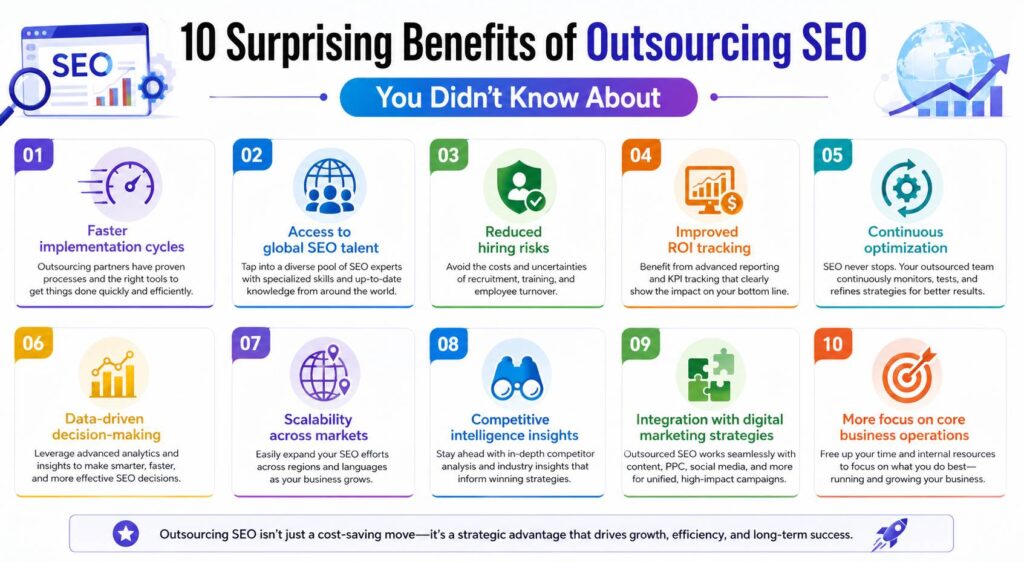
10 Surprising Benefits of Outsourcing SEO You Didn’t Know About
Drawbacks of Outsourcing SEO
Common Challenges
Communication Gaps
Working with an external team can lead to delays or misunderstandings, especially across time zones or different communication styles. Misaligned expectations may impact campaign execution. Clear communication channels are essential to avoid inefficiencies.
Inconsistent Quality
Not all SEO outsourcing companies maintain consistent standards across deliverables. Variations in content quality, backlinks, or technical work can affect performance. Without proper oversight, results may fluctuate over time.
Dependency on Third-Party Providers
Relying heavily on an external partner can create operational dependency. If the agency underperforms or exits suddenly, it can disrupt your SEO strategy. Businesses may also lose internal knowledge over time.
Risk Mitigation Strategies
Define Clear KPIs
Setting measurable goals like traffic growth, keyword rankings, and conversions ensures accountability. KPIs provide a clear benchmark for evaluating performance. This keeps both parties aligned on expected outcomes.
Maintain Regular Reporting Cycles
Consistent reporting (weekly or monthly) helps track progress and identify issues early. Transparent data sharing builds trust and improves decision-making. It also allows quick adjustments to strategies when needed.
Establish Strong Contracts and SLAs
Well-defined agreements outline deliverables, timelines, and responsibilities. SLAs ensure service quality and accountability from the outsourcing partner. This reduces risks and protects your business interests.
How to Uncover Hidden Costs of Cheap Outsourcing SEO Services
Warning Signs
Unrealistically Low Pricing
If pricing seems too good to be true, it usually is. Extremely cheap SEO often means shortcuts like automated tools, low-quality backlinks, or inexperienced teams. These tactics may deliver temporary gains but can harm rankings long-term.
Lack of Transparency
Cheap providers often avoid sharing clear strategies, reports, or methodologies. You may not know what work is actually being done. This lack of visibility makes it difficult to measure ROI or hold the provider accountable.
Use of Black-Hat SEO Practices
Low-cost services may rely on manipulative techniques like spammy backlinks, keyword stuffing, or cloaking. These violate search engine guidelines and can lead to penalties. Recovering from such damage can be expensive and time-consuming.
Cost Breakdown
Tools and Software
Professional SEO requires premium tools for keyword research, analytics, and audits. Cheap providers often avoid these costs or use limited/free versions, leading to poor insights. This directly affects strategy quality and results.
Labor and Expertise
Experienced SEO professionals demand higher compensation due to their skills and industry knowledge. Low-cost services often rely on inexperienced or overloaded teams. This results in inconsistent execution and lower-quality outcomes.
Strategy and Execution
Effective SEO requires a well-planned strategy tailored to your business goals. Cheap services often skip strategy and focus on generic, repetitive tasks. Without proper planning, efforts fail to deliver sustainable growth.
How to Know That You Are Dealing with Cheap Outsourcing SEO Services
Choosing an SEO provider based purely on low cost can create serious long-term risks for your business. While the initial investment may seem attractive, cheap SEO services often rely on unsustainable practices that can damage rankings, credibility, and even your website’s visibility. Understanding the warning signs early helps you avoid costly recovery efforts later.
Key Warning Signs
Unrealistic guarantees
If an agency promises “instant rankings” or guarantees the #1 spot on Google, it’s a red flag. Search engines like Google use complex, constantly evolving algorithms that no one can fully control. Reliable SEO partners focus on gradual, data-driven improvements rather than unrealistic outcomes.
Lack of transparency
Cheap providers often avoid sharing clear reports or detailed strategies. You may receive vague updates without knowing what work is actually being done. A professional SEO partner will provide structured reports, explain actions taken, and align them with measurable business goals.
Use of black-hat techniques
Low-cost SEO services frequently use risky tactics such as spam backlinks, keyword stuffing, or cloaking. While these methods may produce short-term gains, they often lead to penalties from search engines. Recovering from such penalties can be time-consuming and expensive.
Generic, one-size-fits-all strategy
Cheap agencies typically apply the same strategy across all clients without understanding your industry, audience, or competition. This results in poor targeting and irrelevant traffic. Effective SEO requires a customized approach aligned with your business objectives.
Poor communication and support
Limited communication is another common issue. You may struggle to get updates, clarifications, or strategic insights. Reliable SEO partners maintain consistent communication, ensuring alignment between marketing, development, and business teams.
No focus on technical SEO
Many low-cost providers ignore critical technical aspects such as site speed, mobile optimization, indexing, and structured data. Without a strong technical foundation, even the best content strategies fail to deliver results. This is where integrated teams, like those at Jeel Techsoft, bring added value by combining SEO with technical development expertise.
Low-quality or duplicate content
Cheap SEO often relies on bulk-generated or copied content that lacks originality and depth. This not only affects rankings but also reduces user trust and engagement. High-quality content should provide real value, answer user intent, and support your brand positioning.
Real-World Scenario
Consider a growing e-commerce business that hires a low-cost SEO agency to save budget. Within a few months, they see a spike in traffic driven by irrelevant keywords and spam backlinks. Soon after, rankings drop due to algorithm penalties, and organic traffic declines sharply.
The business then needs to invest significantly more in fixing technical issues, removing harmful links, and rebuilding credibility—ultimately spending more than they initially saved.
What to Look For Instead
Customized SEO strategy
A reliable partner develops a plan tailored to your business model, industry trends, and target audience. This ensures that traffic generated is relevant and conversion-focused.
Transparent reporting and KPIs
Look for clear dashboards and regular reports that track rankings, traffic, and conversions. Transparency helps you measure ROI and make informed decisions.
Integration with development and UX
SEO is no longer limited to keywords—it involves website performance, user experience, and technical optimization. Companies like Jeel Techsoft enhance SEO outcomes by aligning it with website development, UI/UX improvements, and digital transformation initiatives.
Cheap vs Affordable Outsourcing SEO
Here’s a clear and detailed comparison table for Cheap vs Affordable Outsourcing SEO with meaningful 2–3 line explanations:
|
Criteria |
Cheap SEO Outsourcing |
Affordable SEO Outsourcing |
|---|---|---|
|
Pricing Approach |
Extremely low pricing designed to attract quick clients, often sacrificing quality. Costs are minimized by cutting corners in execution. |
Balanced pricing that reflects the value of expertise, tools, and strategy. Focus is on delivering sustainable results within a reasonable budget. |
|
Quality of Work |
Typically relies on generic templates, automation, or inexperienced teams. Deliverables often lack depth and customization. |
Work is tailored to business goals with attention to detail. Experienced professionals ensure consistent and high-quality execution. |
|
SEO Strategy |
Little to no strategic planning—mostly repetitive tasks like bulk link building or keyword stuffing. Focus is on shortcuts. |
Built on data-driven strategies including keyword research, competitor analysis, and content planning. Emphasis is on long-term growth. |
|
Tools & Technology |
Limited or free tools are used, leading to inaccurate data and weak insights. This affects decision-making. |
Uses premium SEO tools for accurate tracking, audits, and optimization. Better tools lead to better strategies and measurable outcomes. |
|
Link Building Practices |
Often uses spammy or low-quality backlinks that can trigger search engine penalties. Short-term gains are prioritized. |
Focuses on ethical (white-hat) link building from authoritative sources. Ensures safe and sustainable ranking improvements. |
|
Content Quality |
Content is often duplicated, poorly written, or keyword-stuffed. It fails to engage users or meet search intent. |
High-quality, user-focused content aligned with search intent. Helps improve engagement, rankings, and brand authority. |
|
Transparency & Reporting |
Minimal reporting with unclear metrics. Clients often don’t know what work is being done. |
Detailed reports with clear KPIs like traffic, rankings, and conversions. Ensures transparency and informed decision-making. |
|
Risk Level |
High risk of penalties, ranking drops, and wasted investment due to poor practices. Recovery can be costly. |
Low risk due to compliance with search engine guidelines. Focus is on stable, long-term performance. |
|
Scalability |
Difficult to scale effectively because of limited resources and inconsistent processes. Growth is unpredictable. |
Easily scalable with structured processes and dedicated teams. Campaigns can expand as business grows. |
|
ROI (Return on Investment) |
Short-term results may appear but are rarely sustainable. Long-term ROI is often negative. |
Delivers consistent, measurable ROI through sustainable strategies. Focus is on long-term business growth. |
What Aspects of SEO Can’t You Outsource?
Brand Voice and Messaging
Your brand voice defines how your business communicates with its audience—tone, style, and personality. External SEO teams can optimize content, but they cannot fully replicate your brand’s authenticity without internal guidance. If messaging is inconsistent, it can confuse users and weaken trust. That’s why businesses must internally define and continuously guide brand communication.
Core Business Positioning
SEO strategies must align with your unique value proposition, target audience, and market differentiation. While an outsourcing partner can execute campaigns, only your internal team truly understands your competitive edge. Misalignment here can lead to attracting the wrong audience or poor conversion rates. Strategic positioning should always be controlled internally.
Internal Customer Insights
Your business has direct access to customer data—purchase behavior, feedback, support queries, and pain points. These insights are critical for creating highly targeted SEO strategies and content. External agencies rely on the data you provide, so without proper sharing, campaigns may lack depth. Keeping this knowledge internal while guiding your SEO partner ensures better results.
What Are Your SEO Outsourcing Options?
Agencies (Structured, Scalable)
SEO agencies offer a full team of specialists including strategists, content writers, and technical experts. They follow structured processes, use advanced tools, and deliver scalable campaigns. This makes them ideal for businesses aiming for consistent growth and long-term results. Agencies are best suited for medium to large businesses needing reliability and depth.
Freelancers (Flexible, Cost-Effective)
Freelancers provide flexibility and lower costs, making them suitable for startups or small projects. They often specialize in specific areas like content or technical SEO. However, managing multiple freelancers can become complex and inconsistent. Quality and scalability depend heavily on individual expertise.
Offshore Teams (Highly Skilled, Affordable)
Offshore SEO teams, especially in countries like India, combine cost efficiency with strong technical expertise. They offer access to skilled professionals at a fraction of local costs. These teams can scale quickly and handle large workloads. However, clear communication and process alignment are essential for success.
Why Do Companies Outsource SEO to India?
Cost Efficiency
India offers high-quality SEO services at significantly lower costs compared to Western markets. Businesses can save up to 60–70% on operational expenses. This allows companies to invest more in scaling campaigns. Cost advantage is one of the primary drivers of outsourcing.
Highly Skilled Professionals
India has a large pool of experienced SEO experts skilled in technical SEO, content strategy, and analytics. Many professionals stay updated with global SEO trends and algorithm changes. This ensures high-quality execution across industries. Expertise combined with affordability creates strong value.
Time Zone Benefits for Global Operations
Indian teams can work in different time zones, enabling round-the-clock productivity. Businesses benefit from faster turnaround times and continuous optimization. This is especially useful for global campaigns. It improves efficiency and reduces delays.
What Should You Know Before Using SEO?
SEO is a Long-Term Strategy
SEO doesn’t deliver instant results—it typically takes 3–6 months to show measurable impact. It requires patience and consistent effort. Businesses expecting quick wins may get disappointed. Long-term investment leads to sustainable growth.
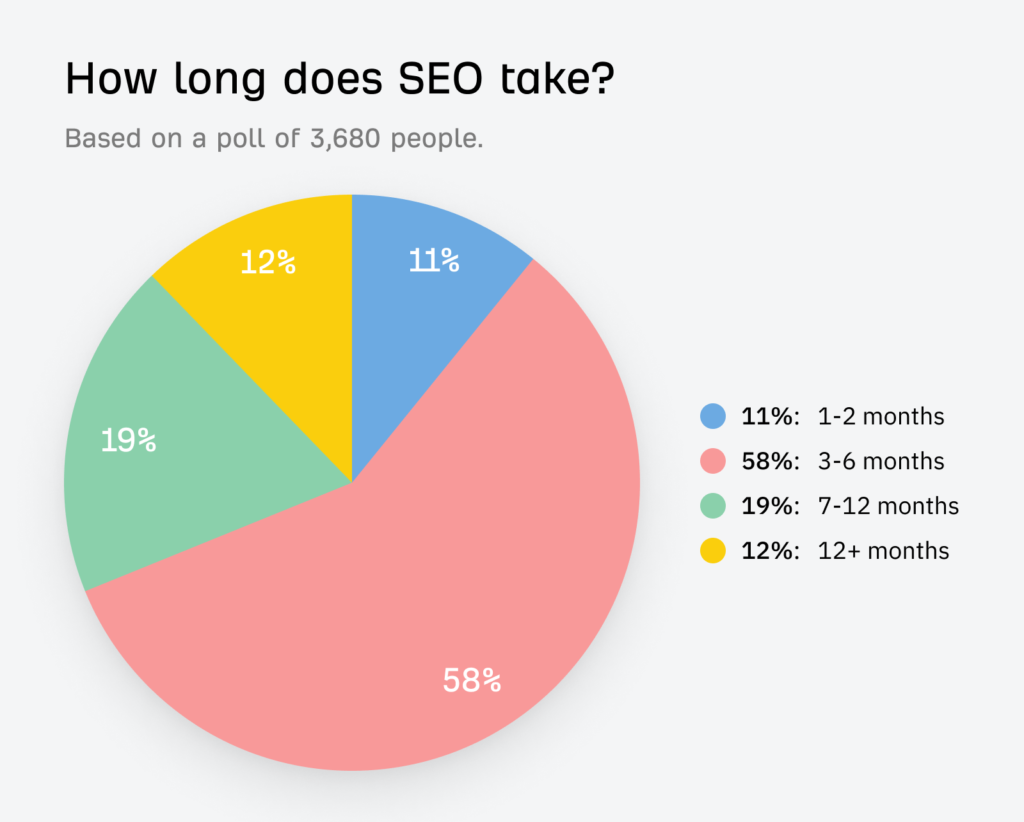
According to ahrefs polls on LinkedIn and Twitter: It typically takes between 3–6 months for SEO to show results. But the reality is that there’s no definitive time frame. It depends.
Requires Consistency
Search rankings depend on ongoing optimization, content updates, and link building. Stopping SEO efforts can lead to ranking drops. Consistency ensures steady improvement and competitive positioning. It’s not a one-time activity.
Needs Synergy Between Content and Technical SEO
Successful SEO combines high-quality content with strong technical foundations. Even great content won’t rank if the site has technical issues. Similarly, a technically sound site needs valuable content to perform. Both must work together.
How Outsourcing SEO Helps Startups Achieve Faster Results
Startups often operate in highly competitive markets where visibility can determine survival. Building an in-house SEO team takes time, hiring costs, and trial-and-error learning. Outsourcing SEO allows startups to bypass these challenges and directly access experienced professionals, proven systems, and advanced tools that accelerate results.
Key Benefits
Faster execution with proven frameworks
Outsourced SEO teams already have structured workflows for audits, keyword research, and optimization. This eliminates the learning curve and allows startups to move quickly from planning to execution. Instead of experimenting, they apply strategies that are already tested across industries.
Access to advanced SEO tools without extra investment
Professional agencies use premium tools for keyword tracking, competitor analysis, backlink audits, and technical diagnostics. These tools are often expensive for startups to purchase individually. By outsourcing, startups gain access to these insights without increasing operational costs.
Cost efficiency compared to in-house teams
Hiring an in-house SEO team requires multiple roles—strategists, content writers, technical experts, and analysts. Outsourcing provides all these capabilities at a fraction of the cost. This allows startups to allocate budgets more effectively across marketing and product development.
Specialized expertise across multiple SEO areas
SEO is not just about keywords—it involves technical optimization, content strategy, link building, and user experience. Outsourcing gives startups access to specialists in each area. This multi-disciplinary approach ensures better results compared to relying on a single in-house generalist.
Scalability as the business grows
Startups often experience rapid growth phases. Outsourced teams can scale efforts quickly—whether it’s increasing content production, expanding keyword targeting, or entering new markets. This flexibility is difficult to achieve with a fixed in-house team.
Integration with website performance and UX improvements
Modern SEO requires alignment with website speed, mobile responsiveness, and user experience. Technology partners like Jeel Techsoft enhance SEO performance by combining optimization strategies with website development and UI/UX improvements. This integrated approach leads to better engagement and higher conversions.
How to Outsource SEO Effectively
Define Clear Business Goals
Start by identifying what you want to achieve—traffic growth, leads, or brand awareness. Clear goals help shape the SEO strategy. Without direction, efforts may become scattered. Goals also help measure success accurately.
Choose the Right Outsourcing Model
Decide whether you need a full-service agency, freelancers, or offshore teams. Each model has different advantages based on budget and scale. Align your choice with your business needs. The right model ensures smoother execution.
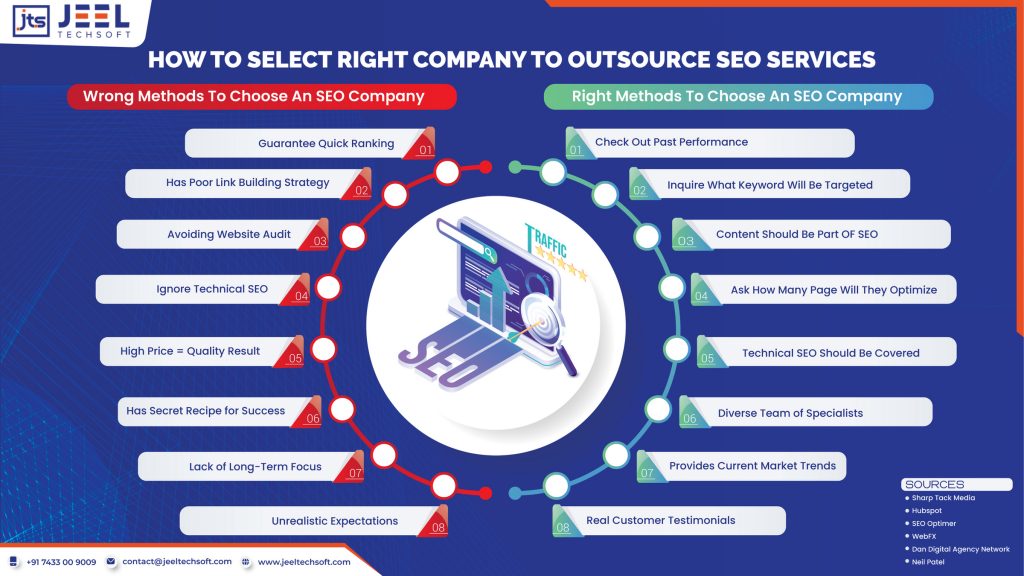
Evaluate Potential Partners
Research agencies or providers based on experience, reviews, and expertise. Look for proven results and industry knowledge. A strong partner can significantly impact outcomes. Avoid choosing based solely on price.
Set Measurable KPIs
Define metrics like organic traffic, keyword rankings, and conversions. KPIs create accountability and clarity. They help track progress and optimize campaigns. Clear metrics ensure alignment between both parties.
Monitor and Optimize Performance
SEO requires continuous monitoring and improvement. Regular reviews help identify gaps and opportunities. Data-driven adjustments improve results over time. Optimization is key to long-term success.
How to Choose the Right SEO Outsourcing Agency
What’s the Cost of Outsourcing SEO?
Monthly Retainers
Businesses pay a fixed monthly fee for ongoing SEO services. This ensures continuous optimization and long-term growth. It’s the most common pricing model. Suitable for businesses focusing on consistent results.
Project-Based Pricing
This model is used for specific tasks like audits or migrations. Costs are fixed based on project scope. It’s ideal for short-term needs. Provides clarity on budget and deliverables.
Performance-Based Pricing
Payment is linked to results such as rankings or traffic improvements. It aligns incentives between client and provider. However, it may involve higher risk. Clear terms are essential for this model.
SEO Monthly retainer rates by region
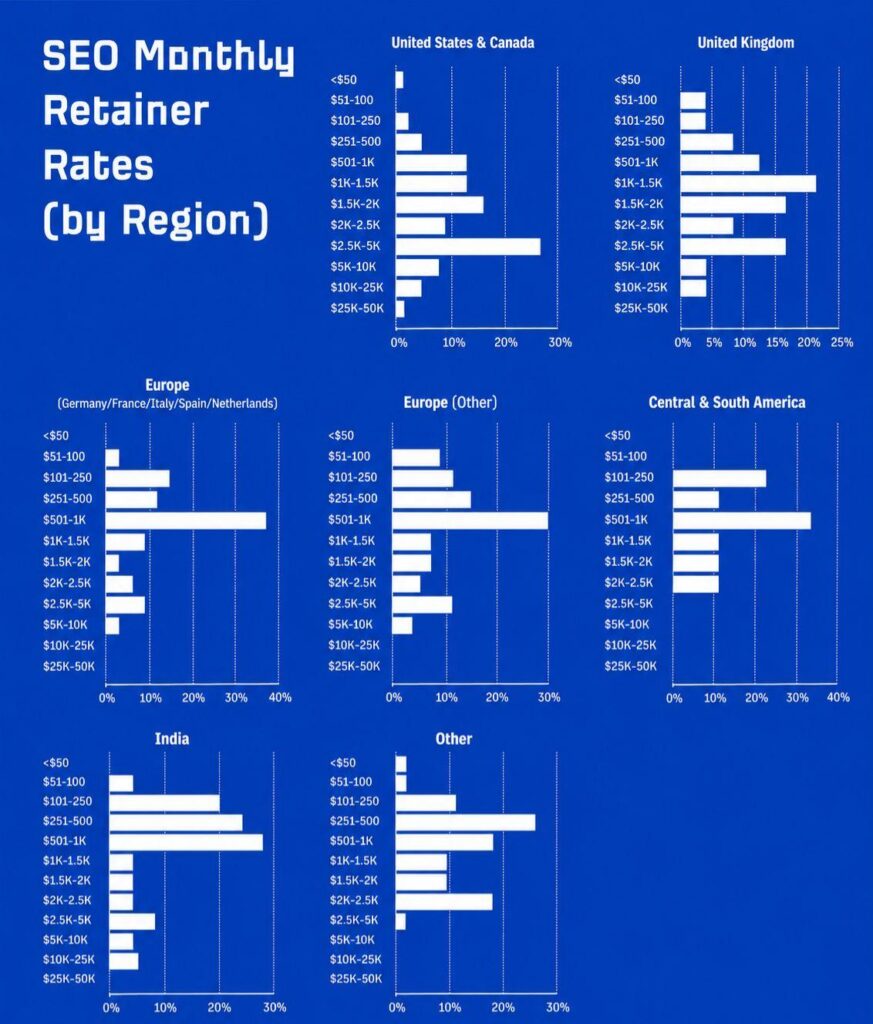
Source – https://ahrefs.com/blog/seo-pricing/
How to Balance Cost and Quality in SEO Outsourcing
Avoid Choosing the Cheapest Option
Low-cost services often compromise quality and use risky tactics. This can lead to penalties and poor results. Cheap SEO may cost more in the long run. Quality should always be prioritized.
Focus on ROI Instead of Cost
Evaluate SEO based on returns, not just expenses. A slightly higher investment can deliver significantly better results. ROI-driven decisions lead to sustainable growth. Value matters more than price.
Evaluate Long-Term Value
SEO is a long-term investment, so focus on lasting impact. Short-term savings can hurt long-term performance. Choose partners that prioritize sustainability. Long-term value ensures consistent growth.
The Impact of Outsourcing SEO on Your Company Culture
Improved Collaboration
Working with external experts introduces structured workflows and better communication. It encourages collaboration between teams. This improves efficiency and alignment. Cross-functional synergy increases productivity.
Access to External Innovation
Outsourcing brings fresh ideas and industry insights. Agencies often experiment with new strategies and tools. This helps businesses stay ahead of competitors. Innovation drives better results.
Reduced Internal Workload
Internal teams can focus on core business activities instead of managing SEO tasks. This improves productivity and efficiency. Delegating SEO reduces stress on internal resources. It creates better operational balance.
How to Integrate Outsourced SEO with Your In-House Marketing Team
Shared Dashboards
Using shared dashboards ensures visibility into performance metrics. Both teams can track progress in real time. This improves transparency and collaboration. Data alignment enhances decision-making.
Weekly Meetings
Regular meetings help align strategies and resolve issues quickly. They ensure both teams stay on the same page. Communication gaps are minimized. Consistency improves execution.
Clearly Defined Workflows
Defining roles and responsibilities avoids confusion and duplication. Structured workflows improve efficiency. Each team knows their tasks and timelines. This leads to smoother operations.
Industry-Specific SEO Outsourcing Strategies
SaaS
Focus on product-led content, feature pages, and technical SEO. SaaS businesses benefit from keyword-driven landing pages and educational content. Technical optimization ensures scalability. It drives user acquisition and retention.
eCommerce
Optimize product pages, categories, and internal linking. Focus on transactional keywords and user experience. SEO directly impacts sales and conversions. Structured data also plays a key role.
Healthcare
Requires compliance with regulations and accurate information. Local SEO is crucial for patient acquisition. Content must be trustworthy and authoritative. Ethical SEO practices are essential.
Real Estate
Focus on local listings, property pages, and lead generation. Location-based keywords are critical. SEO helps attract high-intent buyers. Strong content builds trust.
Travel
Seasonal campaigns and content marketing are key. SEO focuses on destination guides and booking keywords. Trends and timing matter significantly. Content drives engagement and traffic.
E-learning
Content-heavy SEO with blogs, guides, and tutorials. Keyword clustering helps target multiple topics. SEO supports user acquisition and engagement. Educational content builds authority.
Nonprofits
Focus on awareness, storytelling, and donor acquisition. SEO helps reach wider audiences. Content must inspire trust and engagement. Campaign-driven SEO works best.
Local Businesses
Google Business optimization and local citations are essential. Focus on location-based keywords and reviews. SEO drives foot traffic and local leads. Visibility in maps is critical.
The Synergy Between SEO Outsourcing and Paid Media
SEO and PPC Integration
Combining SEO with PPC improves overall visibility. Paid campaigns provide immediate results while SEO builds long-term growth. Together, they maximize reach. Data from PPC can refine SEO strategies.
Retargeting Strategies
SEO brings traffic, while retargeting converts visitors into customers. It improves conversion rates significantly. Retargeting keeps your brand top-of-mind. This creates a full-funnel strategy.
Shared Data Insights
SEO and paid media share valuable data like keywords and audience behavior. This improves targeting and performance. Data-driven strategies lead to better ROI. Integration enhances efficiency.
The Intersection of SEO Outsourcing and Social Media Marketing
Content Distribution
Social media amplifies SEO content reach. Sharing blogs and resources increases visibility. It drives traffic back to the website. This improves engagement signals.
Brand Visibility
Active social presence strengthens brand authority. It indirectly supports SEO through increased recognition. Consistent messaging builds trust. Visibility leads to higher engagement.
Engagement Signals
Likes, shares, and comments indicate content relevance. While indirect, these signals can influence SEO performance. Higher engagement boosts content reach. It strengthens overall digital presence.
Mistakes to Avoid with Outsourcing SEO
Choosing Based on Price Alone
Focusing only on cost can lead to poor-quality services. Cheap providers may use harmful tactics. This risks penalties and wasted investment. Always evaluate value and expertise.
Ignoring Reporting
Without proper reporting, you can’t measure success or identify issues. Lack of transparency leads to poor decisions. Regular reports ensure accountability. Data-driven insights are essential.
Poor Communication
Miscommunication can derail SEO strategies. Clear communication ensures alignment and efficiency. Regular updates prevent misunderstandings. Strong collaboration improves results.
AI and Automation in SEO Outsourcing
AI-Driven Content Optimization
AI tools help analyze content performance and suggest improvements. They enhance keyword targeting and readability. This improves rankings and engagement. AI accelerates optimization.
Predictive Analytics
AI predicts trends and user behavior based on data. This helps businesses stay ahead of competitors. Strategies become proactive rather than reactive. It improves decision-making.
Workflow Automation Tools
Automation tools streamline repetitive tasks like reporting and audits. This improves efficiency and reduces manual effort. Teams can focus on strategy. Automation speeds up execution.
Custom vs Pre-Packaged SEO Outsourcing Services
Custom Search Engine Optimization (SEO)
Custom solutions are tailored to specific business goals and challenges. They provide higher ROI and better alignment. Strategies are flexible and scalable. Ideal for long-term growth.
Pre-Packaged SEO
Pre-defined packages offer quick and affordable solutions. They are easier to implement but less flexible. Suitable for small businesses or basic needs. However, they may lack depth.
The Future of SEO Outsourcing
AI-Driven SEO
AI will play a major role in content creation, analysis, and optimization. It will improve efficiency and accuracy. Businesses will rely more on automation. SEO will become more data-driven.
Voice Search Optimization
With the rise of voice assistants, conversational queries are increasing. SEO strategies must adapt to natural language searches. Featured snippets will become more important. Voice SEO will shape future rankings.
Semantic Search Advancements
Search engines now focus on intent rather than keywords. Semantic SEO emphasizes context and relevance. Content must answer user queries effectively. This improves overall search experience.
When Should You Outsource SEO?
During Rapid Growth
When your business is scaling quickly, outsourcing helps manage increased demand. It ensures consistent SEO performance. Internal teams may struggle to keep up. Outsourcing provides flexibility.
When Lacking Expertise
If your team lacks SEO knowledge, outsourcing provides immediate access to experts. It avoids costly hiring and training. Expertise improves results faster. It’s a practical solution.
Expanding into New Markets
Entering new markets requires localized SEO strategies. Outsourcing helps navigate different regions and audiences. It ensures faster market penetration. Global expertise becomes essential.
The Role of SEO Outsourcing in Crisis Management: Keeping Your Online Presence Strong
An SEO crisis can significantly impact your business, often resulting in sudden traffic drops, loss of rankings, or damage to online reputation. These situations may arise due to algorithm updates, technical errors, negative SEO attacks, or poor past practices. Outsourcing SEO during such times provides immediate access to experienced professionals who can diagnose, stabilize, and recover your digital presence efficiently.
How SEO Outsourcing Helps in Crisis Situations
Immediate diagnostics and root cause analysis
Experienced SEO teams quickly conduct in-depth audits to identify the exact reason behind the issue. This includes analyzing algorithm updates, backlink profiles, technical errors, and content quality. Fast diagnosis reduces downtime and prevents further damage to rankings and traffic.
Strategic recovery planning and execution
Once the issue is identified, outsourced teams create a structured recovery plan. This may involve removing toxic backlinks, improving content quality, fixing crawl errors, or restructuring site architecture. A step-by-step recovery approach ensures steady and measurable improvement.
Technical SEO corrections at scale
Many SEO crises are rooted in technical issues such as broken links, indexing errors, slow page speed, or mobile usability problems. Outsourced experts can quickly implement fixes across the website. When combined with development support—such as teams like Jeel Techsoft—these issues can be resolved more efficiently and permanently.
Reputation monitoring and damage control
Negative reviews, harmful content, or bad press can rank highly during a crisis. SEO outsourcing teams help push down negative results by promoting positive, high-quality content. They also optimize branded search results to ensure your business maintains a trustworthy online image.
Competitor and market re-evaluation
During a crisis, competitors may gain visibility while your rankings drop. Outsourced SEO teams analyze competitor strategies to identify gaps and opportunities. This helps reposition your website more effectively once recovery begins.
Content re-optimization and quality enhancement
Outdated, thin, or irrelevant content is often a major cause of ranking loss. SEO experts update existing pages with better structure, improved keyword alignment, and user-focused information. This strengthens your site’s authority and aligns it with current search engine expectations.
The Role of SEO Outsourcing in Brand Building: Enhancing Your Online Identity
In today’s digital-first environment, your brand is often defined by what users see on search engines. SEO is not just about driving traffic—it plays a critical role in shaping perception, trust, and authority. Outsourcing SEO enables businesses to build a strong, consistent, and credible online identity through strategic content, technical optimization, and visibility management.
Key Contributions of SEO Outsourcing in Brand Building
Consistent brand messaging across search channels
Outsourced SEO teams ensure that your content aligns with your brand voice, tone, and positioning. From blog articles to landing pages, every piece of content reinforces your identity. This consistency helps users recognize and trust your brand across multiple touchpoints.
Authority building through high-quality content
SEO experts focus on creating informative, valuable, and well-structured content that answers user queries. Over time, this positions your brand as an industry authority. High-quality backlinks from reputable sources further strengthen credibility and improve domain trust.
Improved user experience and engagement
Brand perception is heavily influenced by how users interact with your website. SEO outsourcing often includes improving page speed, mobile responsiveness, and navigation. Technology partners like Jeel Techsoft enhance this further by integrating SEO with UI/UX improvements, creating seamless user experiences.
Control over branded search results
When users search for your brand, the results they see shape their first impression. SEO outsourcing helps optimize branded keywords, ensuring that positive and relevant content ranks higher. This reduces the visibility of outdated or negative information.
Content positioning for thought leadership
Strategic content such as blogs, whitepapers, and guides helps establish your brand as a knowledge leader. Outsourced teams identify trending topics and create content that reflects expertise. This not only improves rankings but also builds long-term brand equity.
Multi-channel visibility and alignment
SEO is closely linked with other digital channels such as social media and content marketing. Outsourced teams ensure that messaging remains consistent across platforms. This integrated approach strengthens brand recall and improves overall marketing effectiveness.
How SEO Outsourcing Can Support Sustainability and Green Marketing Initiatives
Sustainability is no longer a niche—it’s a core business expectation. SEO helps brands communicate eco-friendly values while reaching conscious consumers actively searching for sustainable solutions.
How SEO Supports Sustainability
Targeting eco-conscious search intent
SEO teams identify and optimize for keywords related to sustainability, such as “eco-friendly products” or “green alternatives.” This ensures your brand appears in front of users who already value environmental responsibility. It improves both relevance and conversion potential.
Content that educates and builds trust
High-quality blogs, guides, and landing pages can highlight your sustainability initiatives. This includes sourcing, production practices, and environmental impact. Transparent content builds credibility and strengthens brand trust among informed consumers.
Optimizing website performance for lower digital footprint
Faster-loading, optimized websites consume less server energy and improve user experience. SEO outsourcing often includes technical improvements like image compression and code optimization. Technology partners like Jeel Techsoft enhance this through performance-focused development.
Aligning brand messaging with green values
SEO ensures consistent communication of sustainability across all digital touchpoints. This includes metadata, content, and structured data. Consistency reinforces brand positioning and improves recognition among eco-conscious audiences.
Common Myths About Outsourcing SEO
Outsourcing SEO is often misunderstood, leading businesses to make cautious or incorrect decisions. Clarifying these myths helps organizations adopt a more strategic approach.
Myth vs Reality
Myth: Outsourcing means losing control
In reality, structured reporting and dashboards give you more visibility into performance. You can track progress, monitor KPIs, and make informed decisions. Good agencies act as partners, not replacements.
Myth: SEO delivers instant results
SEO is a long-term investment that builds gradually over time. Sustainable rankings require consistent effort in content, technical optimization, and authority building. Quick results often indicate risky practices.
Myth: Only large companies outsource SEO
Startups and SMEs benefit the most because they gain access to expertise without hiring full teams. Outsourcing allows smaller businesses to compete with larger players effectively.
Myth: SEO is only about keywords
Modern SEO includes technical performance, user experience, content quality, and authority signals. It is a multi-dimensional strategy that goes beyond simple keyword optimization.
The Role of Data Security in SEO Outsourcing
SEO requires access to sensitive data such as analytics, CMS platforms, and customer insights. Ensuring data security is critical to protect business operations and maintain trust.
Key Security Practices
Controlled access and permissions
Outsourced teams should only have access to the systems necessary for their work. Role-based permissions reduce the risk of unauthorized changes or data exposure. This ensures better control over your digital assets.
Use of secure tools and communication channels
Data sharing should happen through encrypted platforms and trusted tools. This prevents interception or misuse of sensitive information. Secure collaboration is especially important when working with remote teams.
Legal safeguards like NDAs and contracts
Non-disclosure agreements (NDAs) protect confidential business information. Clearly defined contracts outline data usage and responsibilities. This adds a legal layer of protection to your outsourcing relationship.
Regular audits and monitoring
Periodic checks help identify vulnerabilities or unusual activity. Monitoring ensures compliance with security standards and reduces long-term risks. It also builds confidence in the outsourcing partnership.
Impact of SEO Outsourcing on Brand Reputation
Your search presence directly influences how customers perceive your brand. SEO outsourcing plays a key role in shaping and maintaining that perception.
Key Impacts
Improved visibility of positive content
SEO helps push high-quality, positive content to the top of search results. This ensures that users see accurate and trustworthy information about your brand. It strengthens first impressions.
Consistency in brand messaging
Outsourced teams align content with your brand voice and values. This consistency builds recognition and trust across different channels. It also prevents mixed messaging that can confuse users.
Management of negative search results
SEO strategies can reduce the visibility of negative content by promoting stronger, optimized pages. This helps protect your reputation during challenging situations. It also improves overall brand perception.
Enhanced user experience and credibility
Technical SEO improvements lead to faster, more user-friendly websites. A smooth user experience reflects professionalism and reliability. Companies like Jeel Techsoft often support this through UI/UX and performance optimization.
Legal and Compliance Issues in SEO Outsourcing
Outsourcing SEO involves multiple legal considerations, especially when working across regions or industries. Addressing these early prevents future complications.
Key Areas to Consider
Data protection and privacy laws
Businesses must comply with regulations such as GDPR or local data laws. This includes how user data is collected, stored, and used. Non-compliance can lead to penalties and reputational damage.
Content ownership and copyright
Clearly define who owns the content created during the engagement. This avoids disputes over usage rights in the future. Proper attribution and licensing are also important.
Contractual clarity and obligations
Agreements should outline deliverables, timelines, and responsibilities. This ensures accountability and reduces misunderstandings. Well-defined contracts create smoother collaborations.
Cross-border compliance challenges
Working with international agencies may involve different legal frameworks. Understanding these differences helps avoid regulatory issues. It also ensures smoother global operations.
How to Build a Strong SEO Outsourcing Contract
A well-structured contract sets the foundation for a successful outsourcing relationship. It ensures clarity, accountability, and alignment between both parties.
Essential Elements
Clear scope of work
Define exactly what services are included—technical SEO, content, link building, etc. This prevents scope creep and ensures both parties have aligned expectations. Clarity reduces future conflicts.
Defined KPIs and performance metrics
Establish measurable goals such as traffic growth, keyword rankings, or conversions. This allows you to evaluate performance objectively. It also keeps the SEO team focused on business outcomes.
Timelines and milestones
Break the project into phases with specific deadlines. This ensures steady progress and accountability. Regular milestones also help track improvements over time.
Confidentiality and data protection clauses
Include provisions to protect sensitive business information. This ensures secure handling of data and builds trust. Legal safeguards are essential for long-term collaboration.
Exit and transition strategy
Define how the partnership can end and how data or assets will be transferred. This ensures continuity of operations even after the contract ends. It minimizes disruption.
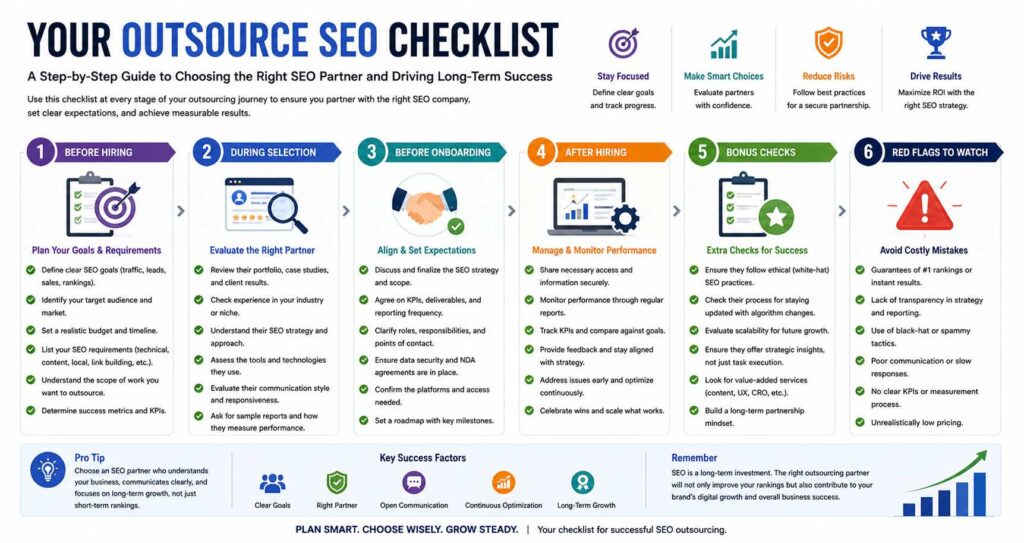
Your Outsource SEO Checklist
A structured checklist helps you choose the right partner and manage the outsourcing process effectively. It ensures nothing important is overlooked.
Project Management Tools and SEO Outsourcing Companies
Effective SEO outsourcing is not just about strategy—it depends heavily on how well teams collaborate, track progress, and communicate. Project management tools act as the backbone of this collaboration, ensuring transparency, accountability, and timely execution. They help bridge the gap between internal teams and external SEO partners.
Common Tools Used by SEO Outsourcing Companies
Trello / Asana – Task and workflow management
These tools help organize SEO activities into clear tasks such as keyword research, content creation, and technical fixes. Each task is assigned with deadlines, priorities, and ownership. This structured workflow ensures nothing is missed and keeps campaigns moving efficiently.
Slack – Real-time communication
Slack enables instant communication between teams, reducing delays caused by emails. Dedicated channels for SEO, content, and development keep discussions organized. This improves collaboration, especially when working with distributed or global teams.
Google Looker Studio – Reporting and dashboards
SEO agencies use dashboards to present real-time data on traffic, rankings, and conversions. Clients can easily track performance without needing technical expertise. This transparency builds trust and supports data-driven decision-making.
Ahrefs / SEMrush – SEO analysis and tracking
These tools provide insights into keyword rankings, backlinks, and competitor strategies. They help identify opportunities and monitor ongoing performance. Outsourced teams rely on this data to refine strategies and improve results continuously.
Additional Benefits of Using Project Management Tools
Improved transparency and visibility
Clients can see exactly what tasks are in progress, completed, or pending. This reduces uncertainty and builds confidence in the outsourcing process. Clear visibility also helps align SEO activities with business goals.
Better accountability across teams
Each task is assigned to a specific individual or team, making responsibility clear. This reduces confusion and ensures timely completion of deliverables. It also helps identify bottlenecks quickly.
Efficient time and deadline management
With timelines and reminders in place, tasks are completed on schedule. This is especially important for SEO campaigns that depend on consistent execution. Delays in one area can impact overall performance, so structured timelines are critical.
Seamless collaboration between SEO and development teams
SEO often requires technical changes such as improving site speed or fixing indexing issues. Tools help coordinate between SEO experts and developers. Companies like Jeel Techsoft enhance this process by integrating SEO with development workflows.
Centralized documentation and knowledge sharing
All strategies, reports, and updates are stored in one place. This makes it easier to review past work and maintain consistency. It also ensures smooth transitions if team members change.
Questions you should ask before outsourcing your SEO Tasks
Before you opt for an SEO agency to perform the tasks for your business, you need to understand their working style, how they handle projects and how you will be benefitted by their offerings. And the best way to know more, is by asking questions. Here are some lists of questions that can help you to know the company better.
Question 1:- Do they work on any specific area or offers the overall package?
Question 2:- What are their strategies to deliver the work?
Question 3:- How they measure the success of the project?
Question 4:- What is their working process when need to work collaboratively with your inhouse team?
Question 5:- Whether they offer back-end support?
Question 6:- How about the payment terms? Whether it is based on milestone completion or before the delivery?
Question 7:- Do they provide any dedicated SOPC (Single Point of Contact) manager for the project of your business?
Question 8:- What are their post go-live support? Do they ask any charges for after-sales support?
Question 9:- Whether they have delivered any similar project earlier? If yes, can they share the details?
Question 10:- How do they manage the Keywork research, link-building and influencer marketing?
Question 11:- What are the tools they use during the project and measure the deliverables?
Question 12:- How do they report the progress of the project with you?
Question 13:- How do you deal if the project is not getting completed on the agreed timeline?


